

Labels in Electronics Manufacturing: Where They Matter
From incoming inspection to reflow and turnover boxes, labels carry the traceability data. What heat, ESD and small sizes demand.
In the field of electronics, the prominent characteristic of electronic components is their "small and precise" nature - their size is often extremely small, to the point where sometimes even key information such as the component's model and specifications are difficult to directly print on the component itself.
However, the characteristics of the industry dictate that the smaller the electronic components, the higher and more stringent the requirements for marking. The electronic manufacturing process is precise and complex. If a component model is used incorrectly or batches are mixed up, subsequent product assembly, testing, and delivery will all encounter cascading issues. The costs of rework and scrap are often doubled or even tripled, potentially even affecting product safety and stability.
Due to the uniqueness and high demands of electronic component identification, self-adhesive labels have become the industry's default preferred medium in this scenario, silently supporting the standardized operation of the entire electronic manufacturing process, thanks to their advantages of flexible adaptability, precise presentation, and stability and durability.
In the incoming stage of electronic components, self-adhesive labels play a pivotal role. Before components are stored, they are typically labeled with unique self-adhesive labels on their outer packaging, trays, or carrier tapes. The labels clearly indicate core information such as model, specification, production batch, supplier information, and storage date. This information must be complete and accurate, and it must accompany the components throughout their entire process, encompassing all subsequent stages.
Once the label information becomes ambiguous, missing, or detaches, subsequent processes such as warehouse inventory, workshop material requisition, and production line setup will be hampered: workers cannot quickly confirm component information, necessitating repeated system checks and manual investigations. This not only slows down the production pace but also significantly increases the risk of material mixing and incorrect usage, affecting production efficiency and product quality.
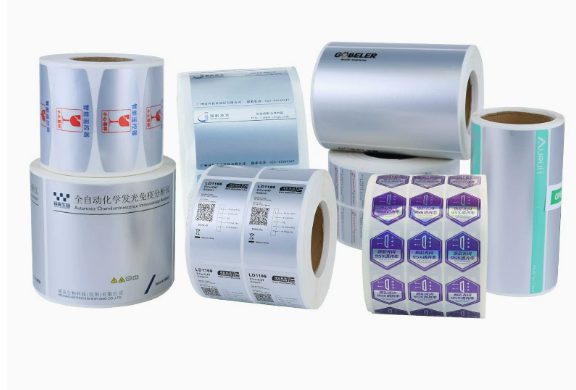
Upon entering the production phase, self-adhesive labels play a pivotal role in "precise differentiation". In electronic production, components of the same model but different batches, or components of the same appearance but varying parameters, often arise. Relying solely on visual inspection is nearly impossible to accurately distinguish them.
At this point, a clear and standardized self-adhesive label becomes the most direct and efficient basis for differentiation - without requiring complex explanations, workers can quickly check the parameters and batch information on the label to accurately identify components, avoiding material mixing and misuse, and ensuring the smooth progression of the production process.
The core characteristics of an electronic production line are fast pace and dense workstations, with every link pursuing efficient connection. This places higher adaptation requirements on self-adhesive labels: if the labels are prone to reflecting light, easily fall off after being pasted, or are not uniformly and normatively attached, they are easily overlooked by workers during high-speed operations, potentially leading to operational errors.
Therefore, in the context of electronic component identification, self-adhesive labels never pursue design complexity, but rather emphasize "stability" and "consistency" - stable adhesion, clear printing, and uniform attachment specifications, in order to adapt to the high-speed operation requirements of electronic production lines and reduce unnecessary downtime and errors.
More crucially, electronic components often undergo complex environmental tests such as high temperatures, static electricity, frequent handling, and wiping during production, warehousing, and circulation processes. Under such conditions, ordinary self-adhesive labels are prone to issues such as curling, warping, adhesive loss, fading of ink, and ink detachment, leading to label failure.
Once the label becomes invalid, the "identity information" of electronic components becomes uncertain. Subsequent processes such as process connection, quality traceability, and warehouse management can only rely on manual judgment, which not only results in low efficiency but also significantly increases the risk of material mixing and misuse, causing unnecessary losses to the enterprise. Therefore, self-adhesive labels specifically used for marking electronic components typically employ special materials and glues that are resistant to high temperatures, static electricity, wear and scratching, as well as water and oil, to ensure that the label remains stable and legible in complex environments over a long period of time.
Another core advantage of self-adhesive labels in electronic component identification lies in its perfect compatibility with barcodes and QR codes, meeting the digital management needs of electronic manufacturing. In processes such as warehouse inventory, SMT line circulation, and test station verification, scanning and recognition are essential actions and core means for achieving digital traceability and efficient management.
The efficiency of reading barcodes and QR codes largely depends on the self-adhesive labels themselves: the smoothness of the label material, printing accuracy, flatness of attachment, and whether they possess anti-reflective properties all directly affect the scanning speed and accuracy of the scanner. Only when the label quality meets standards can "one scan, one pass" be achieved, ensuring the efficient implementation of digital management processes. Conversely, poor label quality can slow down the pace and affect the effectiveness of digital management.
In addition to labels directly affixed to the components themselves, self-adhesive labels also have some easily overlooked yet crucial application scenarios in electronic component identification, such as labeling of turnover boxes, trays, and carrier tapes. Although these labels are not directly attached to the components, they play an important role as "identity substitutes".
As long as the components in the turnover boxes, trays, and carrier tapes remain unchanged, the information on the labels represents the identity of the entire batch of materials. Workers do not need to check the components in the boxes one by one; they can quickly confirm the model, batch, and other core information of the entire batch of materials just by looking at the labels, greatly improving the efficiency of warehouse circulation and workshop material requisition, and reducing the error rate of manual verification.
In the highly sophisticated field of electronic manufacturing, the standardized advancement of many management actions is not achieved through manual memory, but rather through clear and stable identifiers for constraint and guidance. Self-adhesive labels precisely play the core role of such "constraint and guidance".
It will not interfere with the high-speed operation of the electronic production line, nor will it affect the inherent performance of the components. However, it can silently remind at every crucial step: what model this component is, where it comes from, what processes it has undergone, and where it is going now. This clear identification guidance is the foundation for the standardization and normalization of the electronic manufacturing process.
In summary, in the highly sophisticated and efficiently operating application scenario of electronic components, the stability of marking directly determines the stability of the production process and the reliability of product quality. Self-adhesive labels, with their core advantages of flexible adaptability, stability, durability, precision, and efficiency, have become an indispensable core support for electronic component marking, silently empowering the standardized and digital development of the entire electronic manufacturing process, helping enterprises reduce costs, improve efficiency, and ensure quality.