

Outdoor Labels: Stopping UV Fade and Cracking
UV breaks down ink and film from the outside in. Which film, ink and laminate combinations hold in solar, cold chain and chemical use.
In practical scenarios such as industrial equipment, outdoor operation and maintenance, chemical storage and transportation, photovoltaic supporting facilities, and outdoor advertising, self-adhesive labels are not disposable packaging consumables, but rather serve as critical infrastructure for equipment information identification, safety warnings, parameter traceability, and warehouse management. Many companies have misunderstandings in selection, habitually using conventional indoor labels, which are exposed to extreme working conditions such as strong ultraviolet light, alternating high and low temperatures, wind and rain erosion, and acid and alkali corrosion. After about half a year of use, problems such as fading and whitening, surface powdering, substrate cracking, and peeling occur. Blurred label writing and missing information not only affect daily equipment inspections and account reconciliations, but in severe cases, they can also lead to safety warnings being ineffective, equipment parameter traceability being disrupted, and induce production safety hazards, resulting in additional costs for enterprises due to repeated label replacement and construction.
Many people simply attribute the failure of outdoor labels to poor product quality, but in reality, the core cause is the inability of the material system to resist the continuous erosion of ultraviolet rays. Ordinary labels are suitable for stable indoor environments with normal temperature, shaded conditions, and dryness, but they lack the ability to withstand outdoor weathering. To fundamentally solve the problem of labels "dying" in the presence of light and experiencing short-term aging and failure, it is necessary to build a complete weathering system from three dimensions: material selection, ink formulation, and protective technology, to accommodate the needs of different extreme scenarios. Based in Xuzhou and deeply rooted in the Huaihai Economic Zone, Xuzhou Huaishi Electronic Technology Co., Ltd. specializes in customizing weather-resistant labels for outdoor and extreme working conditions. Familiar with the regional outdoor exposure, seasonal temperature differences, humid and rainy climate characteristics, and industrial production conditions, we can provide precise and suitable solutions for sun-resistant, anti-corrosion, and anti-aging labels for various enterprises.
HuaiShi Technology provides services covering the entire market of Gulou District, Yunlong District, Quanshan District, Jiawang District, Tongshan District, Fengxian County, Peixian County, Suining County, Xinyi City, and Pizhou City in Xuzhou. It deeply empowers industrial, photovoltaic, chemical, and logistics enterprises in the Huaihai Economic Zone, including Lianyungang, Suqian, Suzhou, Huaibei, Zaozhuang, Linyi, and Jining. Relying on a comprehensive weather resistance testing system and practical experience, it addresses the issue of label aging and failure in various extreme environments.
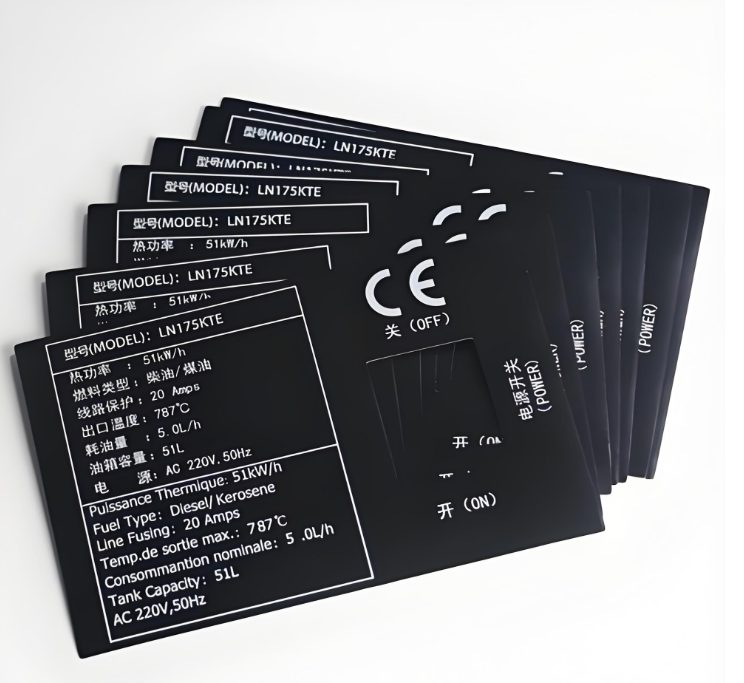
Hardcore science popularization: Analyzing the core causes of outdoor label fading and powdering
The primary culprit behind the aging and failure of outdoor labels is the high-energy ultraviolet (UV) radiation in sunlight. From the perspective of material chemistry, the label substrate and printing ink contain a large number of chromophore molecular chains and high-molecular structures. UV photons with high energy can directly penetrate the chemical bonds of the material, disrupting the stable structure of the ink chromophores, leading to the gradual decomposition and loss of pigments. Visually, this manifests as label fading, whitening, and graying. Simultaneously, UV radiation continuously catalyzes the oxidation reaction of the substrate, causing the molecular chains of ordinary paper and plastic materials to break and become brittle. When combined with outdoor temperature differences and erosion from wind and rain, irreversible aging issues such as surface powdering, cracking, curling, and detachment occur.
The xenon lamp aging test, as stipulated in industry standards, serves as a core method for simulating the combined effects of long-term outdoor exposure, high temperature, and humidity. It provides a direct means of distinguishing the performance gap between conventional labels and weather-resistant labels. After undergoing hundreds of hours of xenon lamp aging testing, ordinary copperplate paper and ordinary adhesive materials exhibit extensive fading, powdering of the paper surface, and brittle and damaged substrate, rendering them completely incapable of retaining clear information. Conversely, specialized weather-resistant substrates such as PET, PP synthetic paper, and thickened PVC demonstrate enhanced molecular structure stability. When combined with UV-resistant formulations, they can withstand long-term UV exposure, maintaining clear layout, intact substrate, and stable color even under simulated outdoor exposure conditions for several years.
Based on a large number of practical industry cases, it is evident that upgrading to a single material alone cannot completely solve the aging problem. Some companies opt for high-priced outdoor base materials, but paired with ordinary indoor inks and unprotected processes, they still encounter the issue of rapid ink fading. For truly long-lasting and durable outdoor labels, it is necessary to establish a systematic weather-resistant protection system, rather than relying solely on material upgrades.
Weather-resistant golden combination: Three-dimensional system solidifies the anti-aging capability of labels
Based on long-term testing and practical experience in outdoor extreme conditions, the industry has developed a mature weather-resistant label configuration logic, which is a sun-resistant golden combination suitable for all outdoor scenarios: UV-resistant special surface material + weather-resistant UV-resistant ink + physical protection through laminating. The three elements work together to comprehensively resist UV rays, high temperatures, rainwater, and oxidative erosion, achieving long-term stability of the label.
Anti-UV special surface material is the fundamental guarantee for weather resistance. It abandons ordinary copperplate paper that is prone to aging and not sun-resistant, and opts for industrial-grade weather-resistant substrates such as PET polyester, PP synthetic paper, and thickened PVC. These substrates have undergone UV resistance modification treatment, with stable polymer structures that are not easily damaged by UV light. They exhibit excellent resistance to stretching, cracking, and aging, and can adapt to outdoor exposure and high and low temperature alternating environments for a long time, effectively eliminating issues such as substrate powdering, cracking, and deformation from the root.
Weather-resistant UV-resistant ink is the core key to locking in color. Ordinary printing ink pigment molecules have poor stability and quickly decompose and fade when exposed to UV light. Specialized weather-resistant ink incorporates UV absorbers and light stabilizers, which can effectively buffer and consume high-energy UV photons, protecting the ink's chromatic structure from being damaged, significantly delaying the fading rate, and ensuring long-term uniform color and clear handwriting on labels, suitable for years of outdoor long-term use.
Lamination physical protection serves as the ultimate reinforcement barrier. Through the lamination processes of matte film, glossy film, and scratch-resistant and weather-resistant film, a transparent protective layer is formed on the surface of the label, shielding it from direct UV rays, rain wash, dust abrasion, and air oxidation. Additionally, it resists outdoor wind and sand friction, as well as intentional scratching and damage, further enhancing the label's sun resistance, waterproofing, wear resistance, and anti-aging properties, significantly extending the outdoor service life of the label.
Precise selection based on segmented scenarios, and specialized material adaptation solutions for extreme operating conditions
The core wear and tear factors vary across different outdoor and extreme scenarios, making a single weather-resistant label inadequate for all-scenario needs. By considering industrial practical operating conditions, it is possible to precisely match specific materials and processes based on four major variables: temperature, humidity, corrosion, and light exposure, thereby avoiding either excessive or insufficient performance.
In the outdoor supporting scenario of photovoltaic panels, the core requirements are high temperature resistance, strong UV resistance, and weather stability. Photovoltaic equipment is exposed to the sun all year round, and the panel surface temperature can be extremely high in summer. Ordinary labels are prone to deformation, fading, and peeling due to high temperatures. For optimal selection, it is recommended to use thickened PET UV-resistant labels, paired with high temperature and weather-resistant ink and laminating processes, which can simultaneously resist high temperature aging and UV fading, maintaining clear and firm labeling throughout the year, and meeting the long-term outdoor operation and maintenance traceability needs of photovoltaic modules.
In the outdoor turnover scenario of cold chain logistics, the core pain points are low-temperature freeze cracking, condensation water immersion, and alternating temperature aging. Low-temperature environments can make ordinary plastic substrates hard and brittle, and wet condensation water is prone to causing edge warping and debonding. Soft low-temperature resistant PVC and modified PP weather-resistant labels are suitable, paired with waterproof low-temperature resistant glue, which combines UV resistance, sun resistance, condensation resistance, and low-temperature resistance, suitable for complex working conditions throughout the year in cold chain vehicles and outdoor storage turnover equipment.
In the scenario of chemical pipeline and chemical barrel identification, the core risks are acid-base corrosion, chemical volatile erosion, and outdoor exposure aging. Ordinary labels quickly deteriorate and ink falls off when exposed to chemical media, posing a potential safety hazard due to ineffective identification. Dedicated thickened PVC and corrosion-resistant synthetic paper weather-resistant labels combine UV resistance, acid-base resistance, and solvent resistance, withstanding chemical volatile corrosion and outdoor strong light aging. This ensures long-term integrity and effectiveness of safety warnings and equipment parameter identifications, mitigating safety production risks.
Industry Summary
The aging and failure of outdoor labels are not accidental quality issues; they are mostly avoidable problems caused by mismatched scene selection and incomplete protective systems. Continuous ultraviolet erosion and complex environmental conditions are the core incentives for outdoor labels to fade, powderize, crack, and fall off, directly affecting the standardization and safety of enterprise equipment maintenance, safety control, and warehouse traceability.
Upgrading from a single common material to a three-dimensional weather-resistant system featuring UV-resistant surface materials, weather-resistant inks, and protective laminating is the optimal path for enterprises to solve the problem of "label failure upon exposure to light." Tailored weather-resistant label solutions specifically designed for niche scenarios such as photovoltaics, cold chain, chemical industry, and outdoor equipment can not only significantly reduce the hidden costs of later replacement, maintenance, and rework but also ensure long-term stability and effectiveness of equipment identification and safety warnings, laying a solid foundation for enterprise safety production and refined operation and maintenance. Based in Xuzhou and serving the Huaihai Economic Zone, Huaishi Electronic Technology relies on a comprehensive range of weather-resistant label systems and scene-specific selection experience to provide highly adaptable and long-lasting custom label services for extreme working conditions to regional industrial enterprises, helping enterprises to thoroughly solve the problem of outdoor label aging and failure.