Removable Labels: How Long, and Any Residue
Removable adhesive is not permanently removable. Dwell time, substrate and temperature decide whether it still peels clean.
When a customer asks for removable labels, the real question is whether the label will leave a ring of adhesive behind after their service cycle. There is no single answer, because removable describes a range, not a switch.
What actually separates removable from permanent
The difference is not whether it sticks, but how. Permanent adhesive gradually wets out into the substrate, and on removal the adhesive layer fails cohesively, leaving part of itself behind. That is intended behaviour. Removable adhesive starts with lower tack and a stable peel value, but the adhesive is built with high internal cohesion, so the whole layer travels with the label and the surface stays clean. Typical 180 degree peel values fall between 1 and 3 newtons per 25 millimetres for removable grades, against 8 to 15 for permanent ones. That is a multiple, not a percentage.
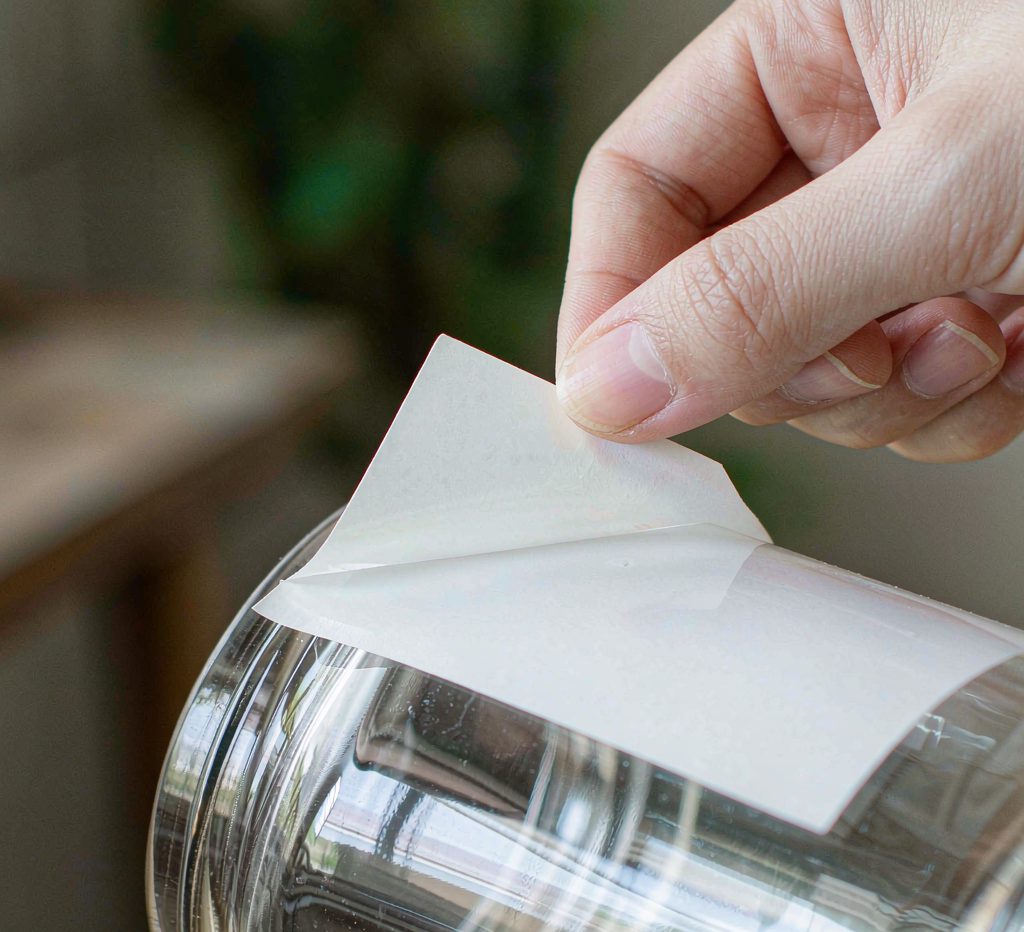
Time is the harshest variable
Removable adhesive gains adhesion over time. Peel it after a week and it lifts easily. Peel it after three months and it needs a slow, deliberate pull. Peel it after a year and many products behave like permanent grades. Tackifying resins migrate toward the interface, and repeated temperature cycling lets the adhesive settle into the surface.
Heat accelerates this. A workshop that sits above 35 degrees Celsius through summer ages the bond far faster than a warehouse held at 20. The same grade can draw complaints of three months in the south and hold for six months in the north, and that is environment rather than a bad batch.
The substrate decides the outcome
Glass, stainless steel, glossy PET and rigid PP release cleanly, with the adhesive leaving as one piece. Paper, textile, wood, textured powder coating and flexible PVC hold on, because the surface has pores or deforms under pressure and the adhesive flows into it. Low temperature is the other trap. Below about 5 degrees Celsius the adhesive stiffens and peel strength climbs, so a hard pull tears the paper and leaves fibres stuck to the surface.
Sample it at three points in time, not one
The proper method is to apply the same sample batch to the actual substrate and re-test at 24 hours, 7 days and 30 days. Peel at 180 degrees and a slow, steady rate, close to 300 millimetres per second, and watch three things: whether the pull force clearly increases, whether a hazy adhesive shadow remains on the surface, and whether the label itself curls or the paper tears. If the 30 day reading already needs real force, the grade will not last your cycle.
Writing the intended dwell time into the specification does more good than the word removable. State the substrate, the ambient temperature, how long before removal and how clean the surface must be afterwards. Given only the word removable, a supplier will default to a standard removable grade, and if it outstays its design life nobody has made a mistake on paper.
If residue is already there, work from the mildest method upward. Isopropyl alcohol lifts adhesive from glass, metal and rigid plastic, wiped dry straight afterwards rather than left to evaporate. A little vegetable oil left to soak softens the shadow paper labels leave and suits surfaces that dislike solvents. Warming the adhesive to around forty degrees Celsius with a hair dryer releases it in one piece over larger areas. Commercial removers are fastest, but test a corner first, because some plastics and acrylic haze permanently.
Prevention is cheaper than any of this. Residue cases almost always share one trait: the label stayed far longer than the grade was built for, or it went onto a porous surface in the first place.