

Frayed Die-Cut Edges and Labels Lost in the Matrix
Frayed edges and labels pulled away with the waste are rarely a dull blade. Check cut depth, tooling, liner and stripping angle in that order.
Two problems haunt the die cutting station. One is a frayed edge that will not tear cleanly. The other is the waste matrix leaving with the labels attached to it. Both look like a blade problem, but the causes are far apart, and guessing wrong means changing good tooling for nothing.
Decide first: too shallow or too deep
Hold a finished label against the light and look at the edge. Ragged, fibrous edges and a label that drags when lifted from the liner mean the cut is too shallow, the face stock was never fully severed. A clean edge where labels ride away with the matrix, or where the web breaks, means the cut is too deep and the blade has scored the liner, weakening it until the waste pulls the labels along.
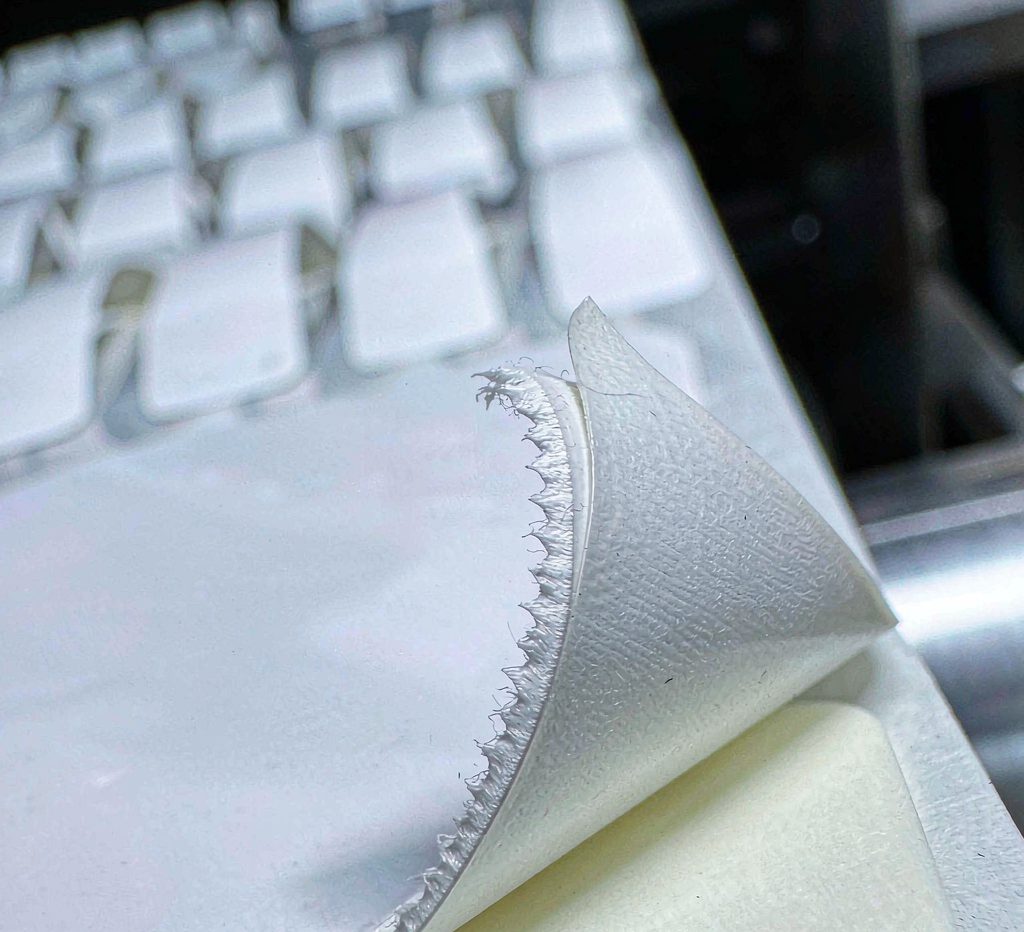
The two faults need opposite corrections. Too shallow means more pressure or a tooling height check. Too deep means less pressure, a different liner or a tooling adjustment. Nothing else can be diagnosed until you know which one you have.
Three things about the tooling itself
Blade angle, commonly between 30 and 42 degrees. A sharper angle cuts cleanly but the edge is weaker; a broader angle is more durable but needs higher pressure. Height tolerance across the die. If the cutting rule is not consistent, pressure distributes unevenly and one half of the label cuts through while the other does not, which is the most common hidden fault in the whole process. Then the rubber compressible strip either side of the rule, which pushes the face stock back onto the liner. Once it collapses or lifts off, the blade carries the label up at the moment of cutting and the edge frays.
Tooling has a service life. In normal production a die runs somewhere between 300,000 and 800,000 impressions before it needs sharpening or replacement, depending on how abrasive the face stock is and how the pressure is set. PET and synthetic stocks shorten that life noticeably compared with coated paper.
Do not overlook the liner and release force
Glassine liners commonly run 62 to 80 gsm, and PET release films around 50 microns. A liner that is too thin lacks tensile strength and deforms during stripping. Release force that is too low is the other main cause of labels leaving with the waste: the release layer is so slippery between waste and label that the stripping roller takes both. Smooth stripping usually needs release force in the middle of the range the machine tolerates, and lower is not automatically better.
Stripping angle and tension
The stripping angle normally sits between 90 and 140 degrees. Too steep and the waste resists peeling hard enough to drag labels with it. Too shallow and the waste starts tearing near the cutting edge, which frays the label edge. Tension follows the same logic. Excessive rewind tension stretches the web, shifts register and leaves edges uneven.
A five minute check on the floor
First inspect the edge to decide the direction of the cut depth error. Second stop the machine and run a finger along the cutting rule to feel for height variation, and look at whether the compressible strip has collapsed. Third run a roll of the same specification from a different lot; if the fault disappears, the liner or its release force is the cause. Fourth adjust stripping angle and rewind tension one step and run fifty metres. Those four steps usually locate the fault faster than swapping tooling on instinct.