

Blow-On or Tamp-On for Curved Bottles
The tighter the curve and the faster the line, the more blow-on wins. But it demands stiffer stock and static control, or labels fly off course.
Two labelling lines, same job. One presses the label onto the bottle with a pad or a roller. The other fires a burst of compressed air and lets the label fly. Both work. Which one fits depends on the bottle, the speed and the label itself.
How each method works
Tamp-on is mechanical contact. The label leaves the peel plate, a pad or roller presses it against the bottle, and pressure brings adhesive and surface together before a roll squeezes air out from one end to the other. The label is constrained by machinery the whole way, so its position stays predictable.
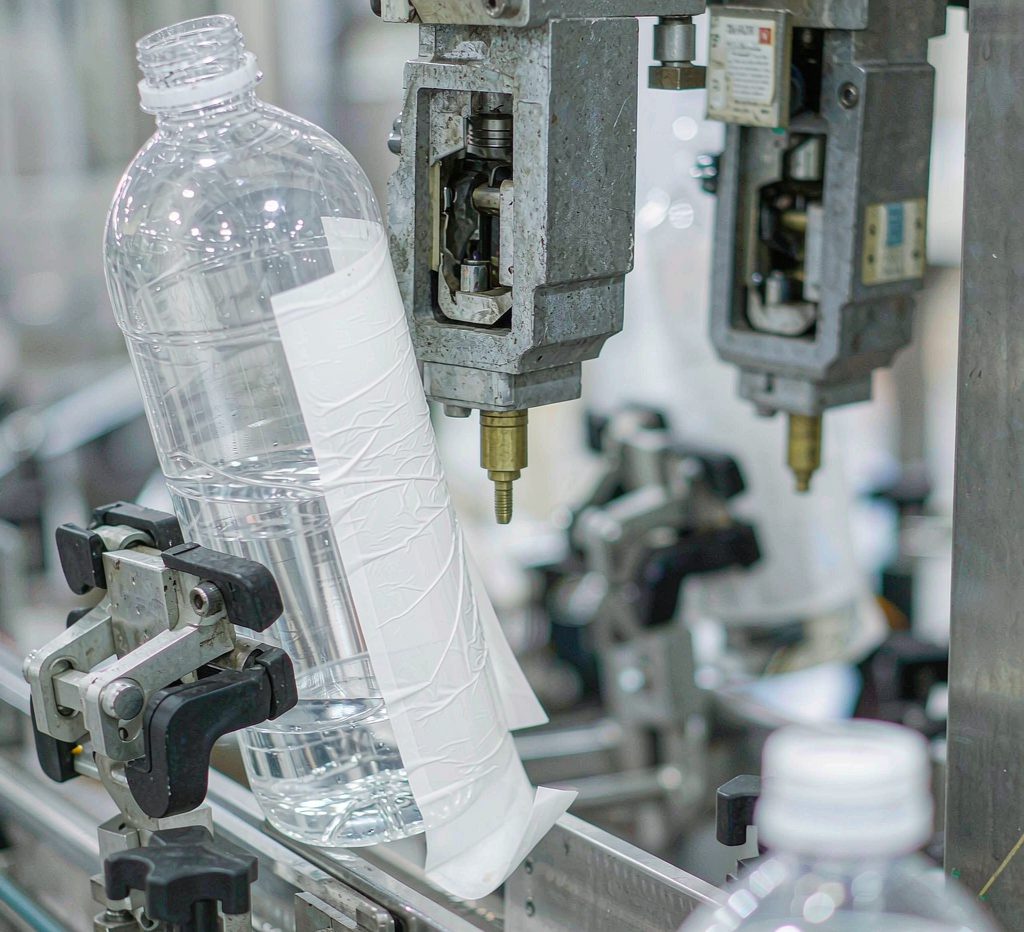
Blow-on is non-contact. As the label releases from the liner, a set of directed nozzles pushes it toward the bottle with an air stream, and air pressure plus the label's own inertia do the applying. The label travels free for a few millimetres to more than ten, and during that flight its orientation belongs to the airflow.
Where blow-on wins
Irregular and curved surfaces first. On a neck, a taper, an oval bottle or a body with reinforcing ribs, a roller touches only a line and pressure distributes unevenly, while air is compliant and wraps around the contour. Thin walled and soft bottles second. A tamp head applies mechanical force and can deform or crush a soft bottle, whereas air applies far less load. Speed third. Air application needs no mechanical reciprocation, so line speed climbs, and machines running one or two hundred bottles a minute are ordinary.
There is a fourth. Some bottles carry a textured or frosted surface where a tamp head traps air under the label. Air pressure pushes the label into the texture instead.
What blow-on costs you
Stiffness sensitivity first. Too soft and the label curls or folds in flight and lands crooked, or lifts off the peel plate early. Too stiff and it will not follow a tight radius, so the edges stand up. Face stocks between roughly 80 and 120 microns tend to be stable for blow-on, depending on the bottle.
Static second. High speed peeling generates static, two labels stick together or cling to a roller, and the one that gets blown is already off course. A production line needs static elimination bars and humidity held between 45 and 60 percent.
Air stability third. Pressure fluctuation moves the label position directly, so the supply needs regulation and filtration, and nozzles need cleaning on schedule. One blocked hole from paper dust and placement drifts immediately.
How to decide
Bottle diameter above 60 millimetres, regular shape, moderate line speed: tamp-on is enough, simpler to build and easier to maintain. Diameter below 40 millimetres, a taper or irregular form, a soft bottle, or a high speed requirement: blow-on fits better. In between, the label size decides. Small labels tend to drift when blown, large labels tend to wrinkle when pressed, so samples are the only honest answer.
A practical test: take the real bottle and the real label, run one hundred pieces on the supplier's machine, and watch three things. Placement deviation within plus or minus one millimetre, no bubbles and no lifted edges, and no misapplied labels across ten continuous minutes. That tells you more than any specification sheet.
Sample two different lots of face stock rather than one. Misapplied labels frequently show up in a single batch, and a single sample will never reveal it.
Check the nozzle plate weekly. A single blocked hole shifts placement by a millimetre or two, and operators usually blame the label before they blame the air.