Component ID Labels: The Underrated Production Link
Small labels on components carry part number, batch and serial data. Why legibility at 3 mm and adhesion on oily metal decide traceability.
In the context of parts management, self-adhesive labels are often treated as mere "accessories," and their core value is often overlooked. However, those who have truly delved into manufacturing and assembly sites understand that any issues with part identification—such as detachment, unclear information, or failed reading—never affect a single part, but rather disrupt the smooth operation of the entire production, assembly, and distribution chain.
The first core challenge of component identification lies in the vast number of parts and the high degree of similarity in their shapes. Components of the same series, with similar shapes but different specifications, are prone to confusion and misuse during storage and production assembly if solely relied on for manual visual differentiation. The core function of self-adhesive labels is to firmly affix key information such as part model, specification parameters, production batch, and installation direction onto the components themselves or their packaging, enabling workers to quickly identify and accurately distinguish them, thereby minimizing the cost and risk of errors in the identification process.
Throughout the entire production process, components are not stored statically but are in a continuous flow state - repeatedly handled, temporarily stored, processed on-line, inspected off-line, and shuttled between different production stations. At this time, self-adhesive labels not only play the basic role of "identifying identity", but also continuously and stably provide key information. Once the labels fall off, wear out, or become illegible, there will be information breakpoints in subsequent processing, assembly, and inspection processes, leading to process stagnation, incorrect or missing assembly, and significantly affecting production efficiency.
There is another extremely practical constraint in component identification - the limited space for labeling. Many components are inherently small in size and complex in structure, leaving very limited space for labeling. This places higher demands on the specifications of self-adhesive labels, the performance of the adhesive, and the quality of the face material. Labels must be small enough to fit into the limited labeling space, while also ensuring clear information printing, scannable readability, and secure attachment. These seemingly simple requirements require precise selection in practical implementation, which is not an easy task.
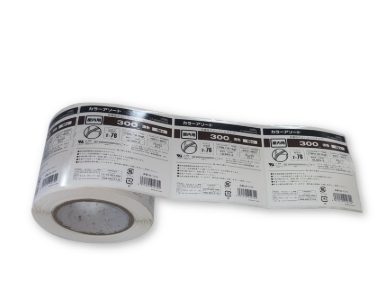
In addition, the complex environment of the production site poses a severe challenge to component identification labels. Oil stains, dust, equipment vibration, and alternating high and low temperatures are common scenarios in the production and circulation of components. Under such conditions, ordinary self-adhesive labels are prone to issues such as edge curling, loss of adhesive strength, and blurry printed text. Once a label becomes ineffective, workers need to repeatedly replenish and reapply it, which not only increases labor costs but also disrupts the production rhythm, leading to a rapid rise in management costs.
In the digital management of most manufacturing enterprises today, self-adhesive labels have long been deeply integrated with barcode and QR code systems, becoming the core medium for the digital management of components. From incoming inspection and warehouse management to production launch and assembly molding, every scanning operation serves as an identity confirmation and data entry. If label reading is unstable - due to blurry barcodes, reflection, or detachment - even the most sophisticated back-end management system cannot guarantee the accuracy of data collection, thereby affecting the effectiveness of digital management implementation.
Another often-overlooked core value is the pivotal role of self-adhesive labels in parts traceability. When a part encounters a quality issue, the ability to quickly trace the production batch, supplier information, and production time through the label directly determines the efficiency of addressing the quality issue and can also minimize the spread of quality hazards. In this context, self-adhesive labels serve as "identity evidence" for each part, assisting enterprises in quickly identifying problems, clarifying responsibilities, and optimizing production.
Based on practical experience from the manufacturing site, the self-adhesive labels that truly fit the components are often not the most exquisite in appearance. Instead, they are those that, once affixed to the components, can withstand the challenges of the complex on-site environment, maintaining secure attachment, clear and readable information, and consistently performing their identification function throughout the entire production, circulation, and usage cycle.
The components themselves are compact in size, yet the information surrounding them, such as model, specification, batch, and traceability, is not straightforward. Self-adhesive labels may seem unremarkable, but they can securely retain and accurately transmit these crucial details, connecting the entire chain of component management and avoiding risks such as confusion, misuse, and traceability gaps. Their role is underestimated precisely because their value is always hidden in every detail of the production site, silently supporting the standardization and efficiency of manufacturing component management.