

Will Your Labels Run on Automated Labeling Equipment
Applicator speed, label gap, web tension and liner stiffness decide whether a label runs on automatic lines. What to confirm before ordering.
After upgrading the automation equipment in the production line, an unexpected issue often arises: despite no malfunctions in the equipment or system, self-adhesive labels frequently cause abnormalities. Common issues include label skewing, scanning failures, web deviation, and print jams. Upon investigation, it is often found that the core problem lies in the labels themselves.
The requirements of automated equipment for self-adhesive labels differ fundamentally from those in manual usage scenarios. Manual labeling allows for a certain degree of error tolerance, with minor skewing capable of being manually corrected; however, automatic labeling machines and integrated printing and labeling machines lack "remedial actions." Any slight instability in label size tolerance, liner stiffness, and label dispensing tension can be magnified by the equipment, resulting in production line failures.
Size and die-cutting accuracy are the most common compatibility issues. Automatic labeling relies on fixed pitch recognition, and unstable label spacing can lead to sensor recognition deviations, resulting in label skewing at the least severe level, and continuous missed labeling at the most severe level. Many on-site misjudgments are attributed to equipment parameter issues, but in reality, they are caused by inconsistent label die-cutting.
The structure of the base paper and the coil material is a key adaptation point that is often overlooked. Automated equipment is highly sensitive to the smoothness of the coil material's movement. If the base paper is too soft, it is prone to stretching and deformation; if it is too brittle, it is prone to breaking; uneven tension can disrupt the labeling rhythm. These issues are difficult to detect during manual use, but they become evident once high-speed automated equipment is employed.
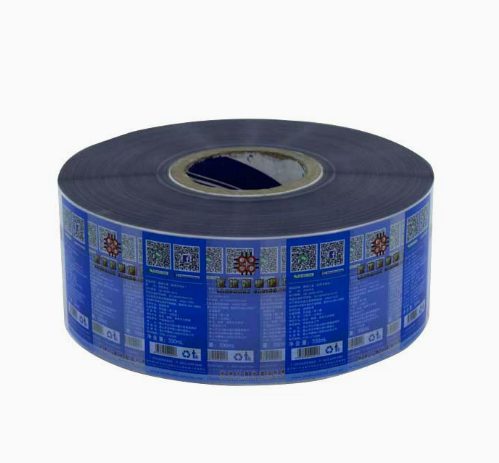
The printing process is also a crucial component of adaptability. Most automated production lines are equipped with industrial label printers to enable online printing of barcode labels. If the label material does not have good compatibility with the thermal transfer ribbon, issues such as ghost printing, grayish ink, and rough edges may occur. Fluctuations in print quality will directly reduce the scanning and reading rate at the backend.
When it comes to scanning adaptability, the surface characteristics of the label cannot be ignored. Automatic scanning devices have a fixed reading angle, and if the label surface is too reflective or the laminating is too bright, it can easily cause reflection interference under specific light sources, leading to failed code reading. Manual scanning can adjust the angle for adaptation, but automated equipment cannot "accommodate" label defects.
In the automatic labeling scenario, the performance of glue is equally crucial. The labeling process by the equipment involves instantaneous pressing, with extremely short contact time. If the initial adhesion of the label is insufficient, it is prone to warping due to rebound after being attached, especially on curved bottle bodies, plastic shells, and other materials, where the compatibility differences are further magnified.
Enterprises with experience in automated labeling projects will conduct joint debugging tests before the official launch: using the same set of equipment, they will operate continuously with different batches of labels to verify stability; they will also perform high-speed continuous label dispensing tests to troubleshoot issues such as stalling and misalignment. Only the label and equipment combination that has passed the full-process testing can be officially put into production use.
Automation equipment seeks operational rhythm and consistency, and the self-adhesive labels that match it must also possess stable output capabilities. The higher the degree of automation of the production line, the more stringent the requirements for the adaptability of basic components such as labels. The stable performance of labels is the core prerequisite for ensuring the smooth operation of the production line.