

What Is a Self-Adhesive Label and Why Packaging Needs It
Face stock, adhesive and liner, and how the three layers behave on different surfaces. Why pressure-sensitive labels dominate packaging.
Upon entering supermarket shelves, express delivery stations, or unpacking home appliances or picking up bottled beverages, we can always see an unassuming self-adhesive label - the brand trademark on a mineral water bottle, the logistics label on a delivery package, the price sticker on supermarket goods, the warning label on the outer shell of an electrical appliance, or even the instruction label on a medicine box. It may seem like a simple sticker, but it has long penetrated into every aspect of modern commerce, logistics, and production, becoming an indispensable core component of the modern packaging system, supporting product identification, brand communication, and efficient supply chain operation.
Many people's understanding of self-adhesive labels remains superficial, only knowing that they can be "pasted", unaware of the rigorous structural design and technological logic hidden behind this small label. The so-called self-adhesive label, scientifically known as "pressure-sensitive self-adhesive label", boasts its core advantage of "no need for additional glue application, simply peel off the backing paper and paste". This convenience is also the key to its rapid popularization and replacement of traditional labels. Unlike the cumbersome process of pasting labels with traditional liquid glue, and unlike the labor-intensive fixation required for sewn labels, self-adhesive labels have an extremely low threshold for use. Whether it's manual pasting or machine batch labeling, they can be efficiently completed, adapting to the production needs of enterprises of different sizes.
A standard self-adhesive label, seemingly simple, actually consists of three core components, each playing a crucial role and indispensable. The face material, as the "carrier" of the label, is responsible for carrying printed graphics and text and conveying product information. Common materials include paper, films (such as PET, PP), and specialized materials. The choice of face material varies greatly depending on different scenarios - food packaging labels often use food-grade paper, which is waterproof and oil-resistant; outdoor equipment labels opt for films with strong weather resistance, capable of withstanding wind and sun exposure; and pharmaceutical labels require non-toxic, degradable specialized materials that meet industry compliance requirements.
Adhesive is the "core soul" of self-adhesive labels. Coated on the back of the face material, it directly determines the adhesion strength and applicable scenarios of the label. High-quality pressure-sensitive adhesives must ensure rapid bonding to the surface of the object during application, while avoiding difficulty in peeling off or residual adhesive stains after bonding. At the same time, they must also be compatible with different attachment surfaces - for example, curved bottle bodies require adhesives with strong flexibility, low-temperature environments require low-temperature resistant adhesives, and high-temperature scenarios require high-temperature resistant adhesives. We have encountered many companies that have chosen the wrong adhesive, resulting in labels curling or falling off after bonding. This not only affects the appearance of the product but may also affect circulation due to missing information, highlighting the importance of adhesive selection.
The base paper serves as the "protective barrier" for the label, primarily protecting the adhesive from dust and moisture contamination before use, ensuring stable adhesion. Commonly used base papers are glassine release papers, which have undergone special surface treatment, allowing for easy peeling from the adhesive without leaving a residue, facilitating the storage, transportation, and use of labels. Many companies tend to overlook the quality of base paper when purchasing self-adhesive labels, unaware that inferior base paper can lead to label adhesion, difficulty in peeling, affecting labeling efficiency, and even damaging the printed graphics on the label surface.
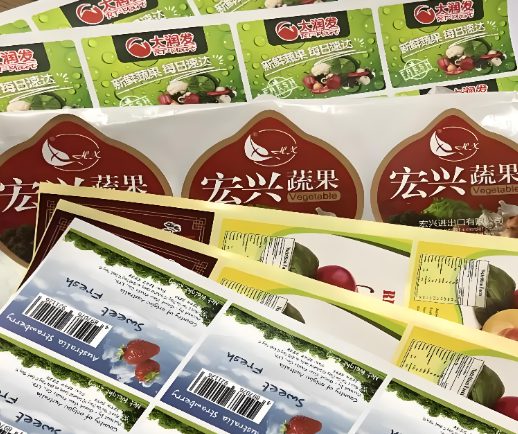
Self-adhesive labels have become an essential requirement for modern packaging, not only due to their convenience but also because of their versatility and wide adaptability. This is their core competitiveness in replacing traditional labels. Compared to traditional liquid glue for label pasting, self-adhesive labels eliminate the need to wait for the glue to dry, ensuring labels are securely affixed immediately after application, significantly enhancing labeling efficiency. This makes them particularly suitable for scenarios requiring rapid labeling, such as e-commerce shipping and mass production of food and beverages. Compared to sewn labels, they do not require damaging the product packaging, resulting in a flat and aesthetically pleasing appearance after application. Additionally, they can be customized and die-cut according to the shape of the product, accommodating various forms such as round bottles and irregularly shaped packaging.
Strong weather resistance is also a major advantage of self-adhesive labels. By selecting different face materials and adhesives, it can achieve functions such as waterproofing, oil resistance, high and low temperature resistance, and UV resistance, adapting to various complex environments. For example, food labels in cold chain logistics can maintain their adhesiveness in a low temperature environment of -20℃, without warping or blurring; outdoor advertising labels can withstand sun and rain, maintaining clear graphics and text for a long time; labels for kitchen and daily chemical products can be waterproof and oil-resistant, avoiding information blurring caused by oil contamination. This strong environmental adaptability allows self-adhesive labels to meet the differentiated needs of different industries.
More importantly, self-adhesive labels are relatively low-cost and can be produced on a large scale. Whether it's large-scale orders for large enterprises or small-batch customization for micro, small, and medium-sized enterprises, cost-effective delivery can be achieved. Many startups and cultural and creative brands can customize self-adhesive labels with their own brand characteristics without bearing high production thresholds, which not only enhances product recognition but also controls packaging costs. This has further promoted the popularity of self-adhesive labels.
From the perspective of application fields, the coverage of self-adhesive labels spans almost all industries in modern commerce and production, undertaking multiple core functions and transcending the mere scope of "simple identification". In the personal care and home care, food, and beverage industries, it serves as the core carrier of brand recognition. The labels on bottle bodies not only convey key information such as product ingredients and shelf life but also present the brand image through design, becoming the first visual touchpoint for communication between the brand and consumers. In the electronics and electrical appliance industry, it undertakes the functions of description, warning, and traceability, marking product parameters and usage precautions to ensure consumer safety. In the pharmaceutical and chemical industry, it is crucial for product compliance, indicating drug ingredients, usage and dosage, and production date to ensure product traceability. In the logistics industry, it is the core of tracking, with express delivery receipts and logistics labels recording recipient information and transportation trajectories, supporting the efficient operation of the supply chain.
With the advancement of Internet of Things (IoT) technology and environmental protection concepts, self-adhesive labels are continuously evolving towards intelligence and environmental friendliness. Smart self-adhesive labels integrate RFID and NFC technologies, enabling product anti-counterfeiting traceability and real-time logistics tracking, becoming an important node in the Internet of Everything. Environmentally friendly self-adhesive labels use degradable surface materials and adhesives, aligning with the "dual carbon" policy and the trend towards green packaging, and are increasingly being adopted by enterprises. Xuzhou Huaishi Electronic Technology Co., Ltd. specializes in the field of self-adhesive labels and can provide customized solutions for different industry scenarios, covering various types such as conventional labels, weather-resistant labels, and environmentally friendly labels. These solutions balance convenience, practicality, and compliance, helping enterprises improve packaging quality and efficiency.
Many companies tend to overlook the importance of self-adhesive labels when designing their packaging systems, considering them merely as "auxiliary stickers." However, this is far from the truth. A high-quality self-adhesive label can not only ensure the clear transmission of product information but also enhance product quality, strengthen brand image, and even optimize supply chain efficiency and reduce operational costs. Understanding the basic structure and core advantages of self-adhesive labels and selecting the appropriate labels based on one's industry scenario is the first and indispensable step for companies to enhance their packaging competitiveness and adapt to modern business development.