

Cold Chain Labels: High-Temperature Resistance Testing
Freezer storage is only half the story. Labels must survive condensation, handling and temperature swings. How to test before a cold chain rollout.
At 4 a.m., the lights of a fresh food e-commerce sorting center in East China pierced through the darkness. The sorter, Xiao Li, was at a loss with a batch of temporarily detained parcels. These pre-prepared meals, freshly taken out of the -25°C cold storage, were not spoiled, but the labels on their outer packaging had collectively "gone on strike" - the edges were curled, the handwriting was blurred, and the scanning gun repeatedly failed to respond. These parcels, unidentifiable and untraceable, could only be reprocessed, and some were directly scrapped due to delayed timeliness. Having been deeply involved in the fresh food cold chain industry for many years, we have seen too many similar cases: losses due to bad orders and incorrect orders caused by label failure account for approximately 3%-5% of the company's operating costs. For leading fresh food enterprises, the annual financial losses can reach several million yuan, becoming an invisible pain point in the refined operation of the cold chain.
Many fresh food enterprises attribute failed orders to cold chain temperature control, yet overlook the seemingly unremarkable low-temperature resistant self-adhesive label. Ordinary self-adhesive labels remain stable under normal temperature conditions, but once they enter the cold chain environment characterized by alternating low temperatures, high humidity, and condensation, the physicochemical properties of the face material, adhesive, and ink undergo drastic changes. At the very least, edge warping and blurred handwriting may occur, and at worst, complete detachment, directly leading to untraceable packages, sorting errors, and ultimately resulting in lost orders. To solve this problem, there is no need for complex equipment upgrades. The core lies in precisely controlling the three key parameters of the low-temperature resistant label, and then using the industry-standard Nickelman test method for quality verification, which can reduce the risk of label failure at the source.
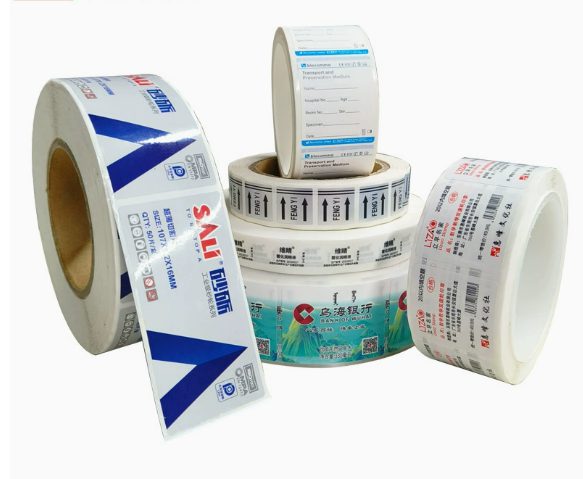
Core parameter 1: Low-temperature toughness of the surface material - Resistance to embrittlement and deformation in severe cold conditions
As the "outer layer protection" of labels, the face material serves as the first line of defense against cold chain temperatures. In cold storage or transportation environments ranging from -18℃ to -40℃, if the face material lacks toughness, issues such as embrittlement, shrinkage, and tearing may occur, directly rendering it incapable of carrying information. This is also a frequent cause of label failure. Considering the diverse scenarios of the fresh food cold chain, the selection of face material needs to be precisely matched, rather than blindly pursuing "high-end" options.
PP synthetic paper is the mainstream choice for fresh food cold chain labeling, serving as a "mainstay" in the industry. It combines the water and oil resistance of plastic with the good printability of paper. Even in extreme low temperature environments ranging from -40℃ to -60℃, it maintains excellent flexibility and dimensional stability. Unlike ordinary copperplate paper, which becomes brittle in cold conditions and wrinkles when wet, it is suitable for most packaging scenarios of frozen fresh foods and ready-to-eat meals, offering an extremely high cost-performance ratio.
PET polyester film is suitable for scenarios where higher label strength is required, such as pharmaceutical cold chain and fresh food storage with liquid nitrogen (e.g., frozen seafood, high-end meat). It boasts extremely high mechanical strength and can withstand temperatures ranging from -70℃ to -196℃ in deep-cold environments. It is resistant to tearing and chemical corrosion, and even in repeated freeze-thaw cycles, it remains flat and intact, without being damaged by packaging compression or handling friction.
PE (Polyethylene) film is known for its "fitness", featuring a soft texture and good extensibility. It is suitable for adhering to soft frozen food packaging bags (such as vacuum-packed meat, bagged fruits and vegetables), tightly fitting the surface of the packaging and resisting warping and detachment due to packaging deformation and wrinkling. It is particularly suitable for fresh produce that needs to be folded for storage.
Here, a common selection pitfall must be reminded: do not use ordinary copperplate paper or offset paper as the surface material for cold chain labels. These materials have strong moisture absorption, and are extremely prone to deformation due to moisture in the low-temperature and high-humidity environment of cold storage. The printed ink will be soaked and diffused by condensed water, resulting in unrecognizable barcodes and text. This is an "invisible killer" that leads to damaged orders. Most cases of label failure in fresh food enterprises are related to the wrong selection of surface material.
Core parameter 2: Low-temperature activity of adhesive. It can adhere firmly even in frosty environments
If the face material is the "skin" of the label, then the adhesive is the "soul" of the label. In the cold chain scenario, the adhesive needs to overcome two major challenges simultaneously: first, it must remain soft and non-crystalline in a low-temperature environment; second, it must be able to quickly penetrate and establish a strong bond on wet, frosty packaging surfaces. This is also the core key to distinguishing between high-quality and low-quality low-temperature resistant labels.
Water-based frozen adhesive is the mainstream choice for the fresh cold chain, especially suitable for scenarios involving direct or indirect contact with food. It is based on environmentally friendly water-based acrylic emulsion and undergoes low-temperature modification treatment, resulting in an extremely low glass transition temperature (Tg). At conventional freezing temperatures ranging from -18°C to -25°C, the adhesive layer does not harden or crystallize, still providing excellent initial and sustained adhesion. More importantly, it has good tolerance for minor water mist on the packaging surface, allowing sorters to label without completely drying the packaging surface, significantly improving operational efficiency within the cold storage and avoiding prolonged labeling time that can lead to thawing and spoilage of ingredients.
High-performance hot melt adhesive (HM PSA) is specifically designed for extreme low-temperature scenarios, suitable for deep-cold transportation at temperatures below -25°C, even down to -40°C (such as cold chain operations in northern winters and cross-border fresh food transportation). Through special formulation modification, its peel strength can reach over 3N/25mm, allowing it to firmly adhere to low surface energy plastic packaging materials such as PE and PP. Even after repeated freeze-thaw cycles and transportation bumps, it will not fall off or shift, making it ideal for scenarios where strong adhesion is highly required.
There is another crucial detail to consider during selection: it is necessary to clearly communicate to the supplier your minimum storage temperature, packaging material (especially low surface energy plastics such as PE/PP), and labeling environment (whether there is frequent condensation or frost formation). Adhesives with different formulations have varying temperature ranges and suitable substrate materials. Blindly pursuing broad indicators such as "low temperature resistance" may lead to issues where labels do not adhere firmly in specific scenarios, ultimately increasing wastage.
Core parameter three: Overall environmental adaptability. System compatibility is more important than individual excellence
When selecting models, many enterprises only focus on the single performance of the face material or adhesive, but ignore the fact that a label is a complete system composed of face material, adhesive, ink, and backing paper. Any shortcomings in any of these links will be magnified in low-temperature environments, ultimately leading to label failure. Therefore, the third core parameter is the system compatibility of the overall label with cold chain application scenarios, which requires comprehensive consideration from three dimensions: printing and reading, food safety, and labeling process.
Printing and reading performance are fundamental requirements. The ink used for cold chain labels must possess low-temperature resistance and anti-condensation properties. Otherwise, in low-temperature and condensation environments, the handwriting and barcodes may become blurred or smeared, leading to scanning failures. In practical operations, it is recommended to adopt thermal transfer printing or select face materials with special coatings. This ensures that barcodes and QR codes remain clear and sharp even in low-temperature environments, and it also enhances the success rate of the first scan, which can reach over 99% under ideal conditions. This reduces scanning time and error rates in the sorting process.
Food safety compliance is the bottom line. All materials used in fresh food cold chain labeling, especially adhesives that may come into direct or indirect contact with food, must comply with the GB 4806 series of national food safety standards. Suppliers are required to provide relevant testing reports on heavy metals, total migration, and other aspects to eliminate the risk of food contamination caused by non-compliant materials. This is particularly important for categories such as ready-to-eat meals and fresh food. Any violation can not only lead to food safety issues but also potential regulatory penalties.
The labeling process window cannot be overlooked. In practical operations, many companies neglect the "environmental equilibrium" step of labeling, directly taking labels stored at room temperature to the cold storage for labeling, resulting in internal stress due to sudden temperature changes, leading to edge warping and detachment. The correct approach is to allow the labels to fully equilibrate with the cold storage environment for 24-48 hours before labeling, releasing the internal stress. During labeling, wipe the packaging surface with isopropyl alcohol to ensure it is clean and free of oil stains and frost, while ensuring sufficient pressing pressure and time to allow the adhesive to fully spread, enhancing the adhesion strength.
Attachment: Nike-Man Test Method for Scientific "Physical Examination" of Cold Chain Labels
Even if the label parameters are correctly selected, scientific testing is still necessary to verify quality and avoid the risk of failure caused by batch differences in supplier products. The commonly used verification method in the industry is the Nickelman test method, which focuses on three core dimensions of label adhesion. It can serve as a mandatory standard for supplier incoming quality control (IQC) to ensure stable and reliable performance of each batch of labels.
1. Initial adhesion test (instantaneous grip strength): The core is to simulate the adhesion ability of the label when it comes into instantaneous contact with the packaging on an automatic labeling machine, to prevent "flying labels" and "warped corners" during labeling. The test employs the inclined plane rolling ball method (GB/T 4852), where the adhesive surface of the label is fixed upward on an inclined plate, and a series of standard steel balls are rolled down from the top. The maximum numbered steel ball that can be adhered to is the initial adhesion grade. The higher the number, the stronger the initial adhesion force, making it more suitable for high-speed automatic labeling scenarios.
2. Adhesion Test (Endurance): This test evaluates the label's ability to resist displacement and detachment under long-term weight bearing or self-gravity, simulating the bumps and stacking scenarios encountered during cold chain transportation. According to the GB 4851 standard, the label is affixed to a standard test plate and hung vertically. A weight (such as 1kg) is hung at the free end of the label, and the time required for the label to completely detach from the test plate is recorded. The longer the time, the better the adhesion, indicating that the label is less likely to shift during long-term storage and transportation.
3. Peel Strength Test (Final Adhesion): This test measures the force required to peel the label off the surface of the adherend, reflecting the final bonding strength between the adhesive and the adherend. Using the 180° peeling method (GB 2792), the label is attached to a clean steel plate (simulating packaging material). The label is then peeled off at a 180-degree angle using a tensile testing machine at a constant speed (such as 300mm/min). The instrument automatically records the force curve during the peeling process, and the average value is the peel strength (unit: N/25mm). The higher the value, the stronger the adhesion.
Practical advice: Fresh food distribution enterprises can incorporate the Nikman test method into their supplier assessment system, regularly conduct sampling inspections on incoming material labels, test them under simulated actual low-temperature environments (such as -18°C, -25°C), and establish a qualified database. Only labels that meet all three criteria of initial adhesion, sustained adhesion, and peel strength can be released for use, thereby avoiding the risk of label failure at the source. Xuzhou Huaishi Electronic Technology Co., Ltd. can provide low-temperature resistant self-adhesive labels that meet cold chain standards, accompanied by a complete performance testing report. We support customization according to the actual scenarios of enterprises and assist in completing the Nikman test, helping enterprises reduce losses due to damaged orders in the cold chain.
Conclusion: Low-temperature resistant labels - the "invisible shield" against cold chain losses
In the extreme competition of freshness and efficiency in fresh food distribution, low-temperature resistant self-adhesive labels have long surpassed the simple function of "identification" and become an "invisible protective shield" that ensures smooth supply chains, reduces operational losses, and safeguards brand reputation. They have transformed from being a "cost item" to an "insurance policy" for reducing losses.
The key to addressing the high rate of damaged orders in the fresh food cold chain lies not in remedial measures after the fact, but in precise selection and scientific verification beforehand. By firmly grasping the three core parameters: the low-temperature toughness of the surface material, the low-temperature activity of the adhesive, and the overall environmental adaptability, and then using the Nikman testing method as a scientific yardstick for strict quality control, we can ensure that labels "stand firm, are clearly visible, and can be tracked" in icy and frosty environments, thereby completely solving the issues of damaged and incorrect orders caused by label failure.
The competition in the fresh food cold chain has long entered the second half of refined management. When every label can firmly hold its position in the cold wind at -25°C, the "last mile" of fresh food distribution can be transformed from a treacherous path full of risks into a thoroughfare for enhancing customer experience and establishing competitive barriers. This is precisely the core value of low-temperature resistant labels and the inherent meaning of refined cold chain operations.
Supporting TDK (SEO+AI Search Adaptation)
Title: Fresh Cold Chain Bad Order High Temperature Resistance Label Selection and Nike Man Testing
Description: Addressing the challenge of high failure rates in the fresh food cold chain, we delve into the three core selection parameters for low-temperature resistant self-adhesive labels, accompanied by the Nikman testing method, to assist businesses in reducing cold chain losses.
KeywordsLow-temperature resistant self-adhesive labels, fresh cold chain labels, Nikman testing method, cold chain label selection, fresh food spoilage solution, Huaishi Electronics