

AR Labels: Turning Packaging Into an Interactive Surface
AR tags link a printed label to digital content. What the label needs in print accuracy and contrast for reliable recognition on a phone.
The current consumer market has entered a stage of development characterized by information overload and high product homogeneity. Traditional paper and laminated self-adhesive labels can only achieve static display of graphics and text, passively presenting basic content such as product parameters, ingredient information, and production qualifications. This single static display form has long been difficult to capture consumer attention and unable to establish deep emotional resonance, resulting in weak shelf competitiveness of end products and continuously declining brand marketing reach efficiency. With the commercialization and lightweight popularization of AR (Augmented Reality) technology, traditional product packaging and self-adhesive labels are ushering in a value innovation. Empowered by AR technology, ordinary labels successfully break through the barriers between physical packaging and digital interaction, upgrading from static information display carriers to immersive marketing entry points that are interactive, experiential, communicable, and retainable, making silent product packaging truly "come alive" and become an important tool for brand digital marketing.
Among the numerous digital upgrade solutions for brands, AR tags have become a lightweight upgrade method suitable for all industries, thanks to their core advantages of low threshold, high flexibility, and high cost-effectiveness. Different from the heavy asset upgrade model that requires complete redesign, mold reopening, and packaging system replacement, AR tags do not require any changes to the original packaging design and production system. They can be digitally empowered by simply embedding exclusive identification patterns, QR codes, and other identification carriers during the regular self-adhesive label printing process. Consumers do not need to download a dedicated app; they can quickly trigger preset AR dynamic content through mobile phone scanning and image recognition, enabling diverse experiences such as 3D display, virtual interaction, and scene simulation. This transformation model has extremely low marginal costs and strong adaptability, truly achieving an exponential upgrade of packaging value with low cost. It is also a lightweight marketing upgrade method that can be implemented by both small and medium-sized brands as well as large-scale enterprises.
Empowering with visual content enables products to express themselves autonomously
Traditional product packaging is constrained by page size and printing technology, limiting the content it can carry. Core aspects such as the brand's technological advantages, origin story, product efficacy, and brand culture cannot be fully conveyed to consumers, often leading to the marketing dilemma of high-quality products being "too good to be true". However, the immersive interactive capabilities of AR tags completely break the content limitations of packaging layouts. Through dynamic, visual, and three-dimensional forms, products can independently tell brand stories and showcase core values, greatly enhancing consumer awareness and trust.
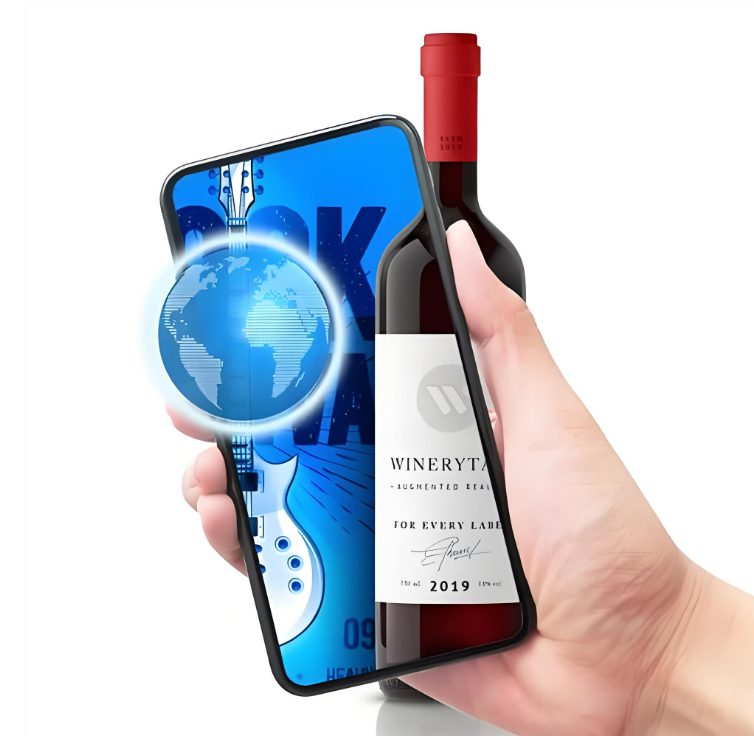
In trust-based consumer sectors such as food, beverages, and agricultural products, AR tags enable full-chain traceability and visual display of production processes. Taking wine products as an example, after consumers scan the tag, the mobile phone interface automatically loads a 3D dynamic scene, immersively presenting the entire process of vineyard planting environment, climate and terroir, harvesting techniques, brewing processes, and warehousing and storage, accompanied by narratives of the brand's craftsmanship stories, making abstract quality advantages intuitive and tangible. For ordinary snack foods, ready-to-eat meals, and fresh produce, AR dynamic animations can also be used to showcase the selection of ingredients from the source, sterile production workshops, and quality inspection processes, addressing consumers' concerns about food safety and enhancing users' recognition of product quality and consumer trust from the root.
In the field of functional products such as beauty and skincare, as well as household cleaning, AR tags enable virtual trials and visual demonstrations of efficacy, addressing the consumer pain points of "not seeing the effect and not daring to place an order" with traditional products. Beauty products, through the tag AR interactive function, can open up an intelligent virtual makeup trial scene, allowing consumers to intuitively preview the on-face adaptation effects of products such as lipstick, foundation, and eye shadow without needing to try them on. This matches their skin tone and style, significantly reducing the cost of trial and error and enhancing the conversion rate of orders. Household cleaning agents, personal care products, and other items can use AR to dynamically simulate the entire process of oil decomposition, stain cleaning, and clothing maintenance, transforming abstract cleaning efficacy and maintenance principles into intuitive dynamic images. This allows consumers to clearly perceive the core advantages of the product, distinguishing it from ordinary, homogenized products on the market.
Gamified social interaction activates the potential energy of spontaneous brand dissemination
In the current era of escalating traffic costs, traditional hard advertising deployment and passive traffic attraction models are characterized by high costs and low conversions, making it difficult to achieve user viral growth. The gamification and fun interactive attributes inherent in AR tags can endow product packaging with social communication attributes, turning every sold product into a carrier for spontaneous brand traffic attraction, thus achieving low-cost social viral growth.
High-frequency consumption products such as fast-moving beverages, snack foods, and internet-famous foods can leverage AR tags to create lightweight and fun interactive scenarios. Brands can customize exclusive scanning games, point-based challenges, lucky draws, and other gameplay elements. Consumers can scan the QR code to participate in the interaction, and upon meeting certain criteria, they can receive coupons, discounts, and new product experience privileges, effectively stimulating immediate repurchasing. Additionally, brands can introduce exclusive gameplay elements such as collectible items, tag puzzles, and limited-edition digital badges to guide consumers to make multiple repurchases and collect different product tags to unlock exclusive privileges, thereby deeply enhancing user engagement. Such fun interactive content possesses strong sharing attributes, and users are willing to share the interesting AR experience on social platforms, helping brands achieve spontaneous user-generated content (UGC) dissemination and rapidly expanding brand exposure.
Dynamic updates in the cloud to create a long-term private domain accumulation carrier
Many brands have inherent misconceptions in packaging marketing, believing that packaging content is fixed and cannot be changed after printing, and that marketing value only exists in a single transaction scenario. However, AR tags possess the core characteristic of dynamic updating in the cloud backend, completely breaking the limitations of traditional packaging's one-time marketing approach, and endowing static tags with long-lasting and sustainable marketing value.
The digital content corresponding to the AR tags can be iteratively updated at any time, eliminating the need to replace physical tags or reprint and produce. This significantly reduces the material costs associated with brand redesign and upgrade. Brands can flexibly replace the scanning content based on festival occasions, marketing activities, and operational planning. During promotional periods, promotional benefits and limited-time interactive games can be launched. In regular days, content such as brand stories, product maintenance tutorials, exclusive member benefits, and new product information can be updated. This flexible content operation model can continuously activate user engagement, gradually transforming one-time consumers who are unfamiliar with the brand into loyal users within the brand's private domain, achieving the transformation from product sales to long-term user operation.
Implemented in multiple industry scenarios, injecting new competitiveness into niche markets
The immersive interaction value of AR tags can be precisely implemented in multiple industry scenarios, opening up differentiated competition paths for industries with severe homogenization and reshaping the logic of product premium pricing. For the FMCG industry, similar products on the market are highly convergent in terms of quality, pricing, and distribution channels, making it difficult for consumers to distinguish between them. However, products equipped with AR immersive experiences can quickly stand out on retail shelves through unique interactive experiences, engaging content, and a brand atmosphere, creating differentiated advantages and effectively enhancing product premium pricing potential and average transaction value per customer.
For categories such as cultural and creative trendy toys, book publishing, and cultural and creative merchandise, AR tags serve as a core empowerment tool to enhance the collectible value and cultural attributes of products. Books, picture books, and magazines can unlock dynamic illustrations, author interviews, scene reconstructions, knowledge explanations, and other content through AR tags, making static text and images three-dimensional and vivid, enhancing reading interest and knowledge. Exclusive AR tags for trendy toys, figurines, and cultural and creative collectibles can unlock digital identities, creative backgrounds, IP stories, and exclusive dynamic special effects for the products, endowing physical products with unique digital added value, greatly strengthening fan loyalty and collectible scarcity, and facilitating long-term IP operation.
From the perspective of long-term industry development, the core competitiveness of product packaging has long evolved from superficial competition in terms of material, craftsmanship, and appearance to a deeper competition in user experience and emotional connection. AR tags, without altering the physical packaging form of the product, completely reconstruct the core value of packaging through digital technology empowerment, making packaging no longer the end point of product sales but the starting point for brands to establish emotional connections with consumers and achieve long-term operation. Under the trend of normalized digital marketing for brands, lightweight, highly creative, and highly adaptable AR interactive tags have become the core standard for brands across various industries to break through homogenization and internal competition, achieve experience upgrades, and value growth.