

Why Wine Bottle Labels Curl at the Neck After an Ice Bucket
The neck is always the first place a wine label fails. Curvature, condensation and mould release agent combine, so plan for it in material and application.
One complaint comes back from beverage clients more than any other. After two hours in an ice bucket the label on the body is intact, and the strip around the neck has lifted at the edge. The cause is not mysterious. Three factors land on the same area at once.
The neck is the hardest curve on the bottle
A standard wine bottle neck runs about 28 to 32 millimetres in diameter against 75 to 80 on the body. A label on the body bends gently because the radius is large. On the neck the radius drops to well under twenty millimetres, so the paper is forced through a sharp bend and the restoring stress concentrates at the edge. Once anything gives way, the edge lifts first.
The applicator also has the least control on the neck. A roller follows a cylindrical body properly. On a tapered neck it only touches a line, pressure falls off at both ends, the adhesive never gets compressed and the initial tack is never realised.
Condensation enters at the edge
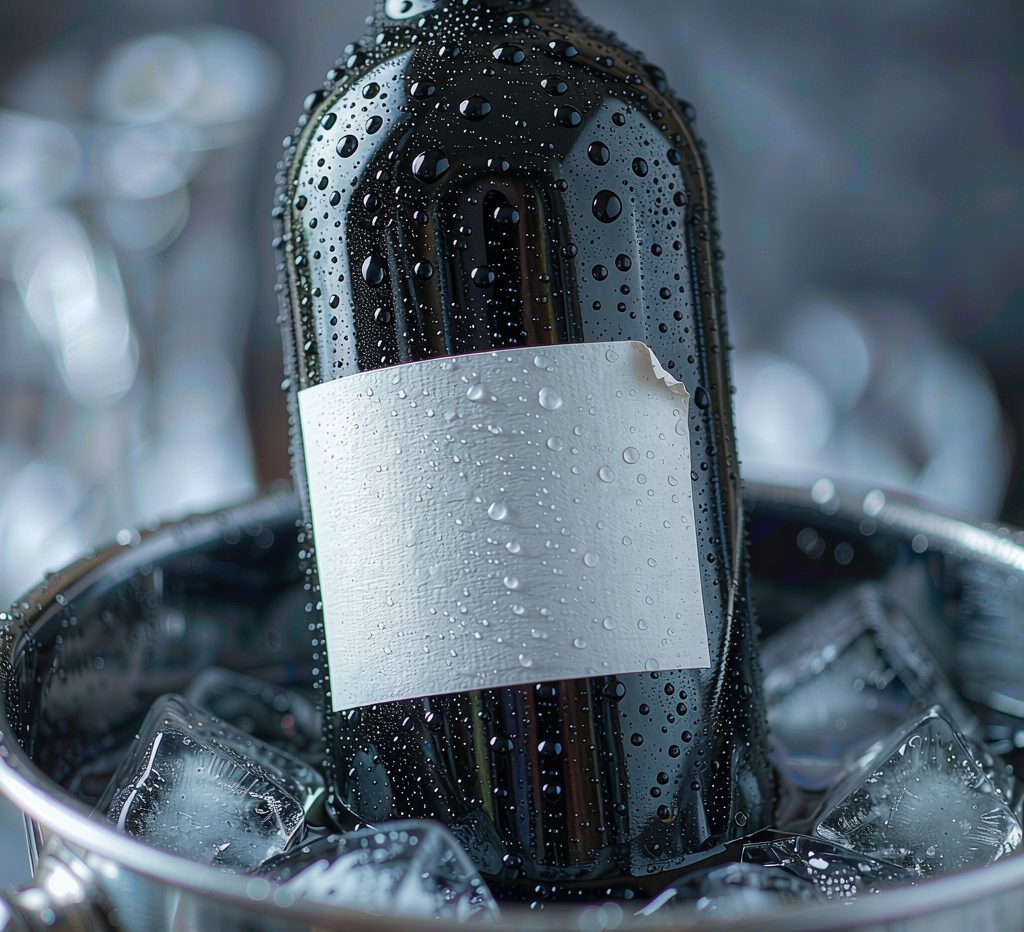
An ice bucket sits at 0 to 4 degrees Celsius. The bottle surface cools fast and moisture condenses on the glass and along the label edge. Paper based face stock absorbs that moisture and swells, most visibly at the edge where only one face is restrained. The swelling pulls the adhesive away in microscopic gaps, water travels further in, and a small lift becomes a full ring.
How fast this happens depends heavily on the face stock. Standard coated paper swells noticeably. Wet strength paper carries a water resistant resin and swells far less. Synthetic paper and PET absorb essentially nothing, and foil is a complete barrier. Textured and felt stocks wick moisture at the cut edge aggressively and often fail within an hour of immersion.
There is also release agent on the glass
New bottles pick up a very thin film of mould release agent during forming. It is invisible, but it drops surface energy sharply, and adhesive applied over it behaves as if applied over oil. A good share of lifting cases end here: switch to washed bottles and the same label performs normally.
The fix is cheap. Wipe the neck with isopropanol before labelling, or ask the glass supplier to control release agent loading. On an existing line, add an air blast ahead of the labelling head.
Four things material and construction can do
Move the face stock to wet strength paper or synthetic, which lifts water resistance a full grade at modest cost. Choose a cold environment or high initial tack adhesive that still grips glass and condensation at 5 degrees Celsius. Leave 2 to 3 millimetres of unprinted white border so the adhesive has a clean bonding margin, since labels printed to the trim edge lift first. And build the neck label as a separate part from the body label, using a thinner, softer stock to reduce restoring stress.
How to test acceptance
The common industry test is an ice bucket soak. Apply the label, immerse the bottle in an ice and water mix at 0 to 4 degrees Celsius for 2 to 4 hours, dry the surface, rest at room temperature for an hour, then measure the lifted edge height. Anything above 1 millimetre counts as a failure. That one test exposes moisture absorption, cold adhesive performance and application pressure together, which a flat sample never will.
Run that test on the real bottle with the real closure before approval, rather than after the first complaint arrives from a customer.