

Auto Parts Labels: Identification Through the Process
Production ID, warehouse movement and traceability all rest on the label. How oil, heat and small print areas shape the material choice.
The automotive parts industry is characterized by a wide range of product categories, diverse model specifications, precise production processes, and numerous circulation links. The same production line often requires the simultaneous production of parts of different models, and within the same warehouse, there is a large accumulation of products with similar appearances and close specifications. Without a clear, standardized, and stable identification system, issues such as confusion, incorrect delivery, and missed deliveries are highly likely to occur in production circulation, warehouse management, logistics, and distribution, directly affecting production efficiency, product quality, and delivery cycles.
As the core information carrier for the full lifecycle management of automotive components, labels have always played an indispensable and crucial role. Self-adhesive labels, with their strong adaptability, ease of use, large information capacity, and outstanding stability, have become the most widely used and mainstream identification solution in the industry. From the process flow in the production workshop, to the precise control in the warehouse, and to cross-regional logistics and distribution, the information transmission in every core link is inseparable from this small self-adhesive label. It serves as both the "identity certificate" of the component and an important tool for the enterprise's fine management.
In the production process of automotive components, precise identification is the core foundation for ensuring orderly production and reducing human errors. Each component, from commissioning to off-line, needs to be bound with complete identity information, including product model, production batch, production date, production line number, team information, quality inspection results, etc. Especially for key core components such as engine components and chassis components, exclusive quality inspection marks and traceability codes are also required to ensure that each product can be accurately tracked.
Self-adhesive labels, with their flexible printing characteristics, can accurately carry all the aforementioned key information. When paired with coding formats such as one-dimensional barcodes and DataMatrix QR codes, they enable rapid identification of information and data synchronization. During the process flow, production personnel can quickly confirm component information with just a simple scan using a scanning device, eliminating the need for manual verification one by one. This effectively avoids errors caused by human judgment, significantly enhances workflow efficiency, and perfectly aligns with the efficient and standardized production pace of the automotive parts industry.
The core difficulty in managing automotive parts warehouses lies in the "wide variety, large quantity, and similar appearance". Relying solely on manual identification not only results in low efficiency but also increases the likelihood of issues such as incorrect picking, misdelivery, and omissions, directly affecting order delivery and production schedules. Self-adhesive labels, with their standardized identification design, have become the key to solving the challenges of warehouse management. They are widely used in various scenarios, establishing a full-process visual warehouse management system.
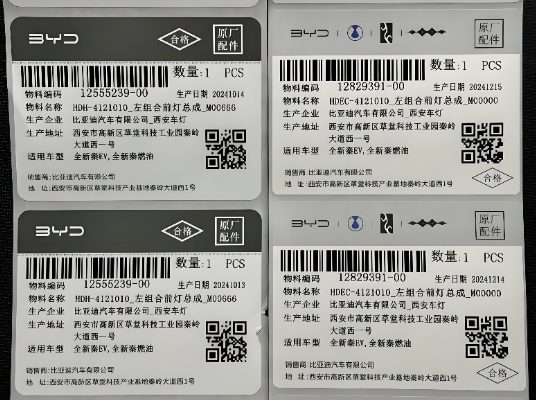
Specifically, self-adhesive labels can be customized into various types such as outer box labels, pallet labels, turnover box labels, and storage location labels according to warehouse management needs. Each type of label is marked with a unique code and core information, enabling seamless integration with the warehouse management system (WMS). During the entire process of warehousing, shelving, inventory checking, picking, and ex-warehouse operations, warehouse personnel can quickly confirm information and synchronize data by simply scanning the label with a scanning device, achieving precise inventory control, significantly improving warehouse management efficiency, and reducing labor management costs and error rates.
The production environment for automotive components is often complex and demanding, with various factors such as oil stains, dust, mechanical friction, and temperature fluctuations prevalent in the workshop. These factors impose extremely high requirements on the stability and durability of labels. Unlike self-adhesive labels used in ordinary scenarios, self-adhesive labels specifically designed for automotive components must exhibit strong environmental adaptability to ensure the integrity of information and secure adhesion under complex working conditions over an extended period.
If ordinary label materials are chosen, they are prone to issues such as edge warping, surface wear, blurry barcodes, and adhesive layer detachment after prolonged exposure to oil, dust, mechanical friction, and temperature fluctuations. Once the label information becomes unreadable, it will directly disrupt production workflows and warehouse management processes, causing unnecessary losses. Therefore, the automotive parts industry has much higher requirements for the stability, oil resistance, friction resistance, and temperature resistance of self-adhesive labels than in ordinary application scenarios. Specialized self-adhesive labels, precisely crafted through the combination of high-quality face materials and specialized adhesives, perfectly adapt to these demanding working conditions.
As the automotive industry's requirements for product quality control continue to rise, a full-process traceability system has become one of the core competencies of automotive parts enterprises. Self-adhesive labels serve as the fundamental carrier and key node in the entire traceability chain. To achieve "one item, one code, and full traceability," each product or batch of products is assigned a unique traceability code, clearly marked on a self-adhesive label, which spans the entire lifecycle of production, inspection, warehousing, shipping, and after-sales service.
When products flow through various stages, staff members scan the label codes using scanning devices, and the relevant data is synchronized in real-time to the enterprise traceability system, accurately recording all key data such as production information, inspection results, warehousing records, and logistics flow. In the event of a quality issue, the enterprise can quickly locate the production batch, circulation path, and scope involved through the label codes, and promptly take measures such as recalls and rectifications to minimize quality risks and brand damage. This is also one of the core reasons why self-adhesive labels are indispensable in the automotive parts industry.
A standardized and normalized labeling system is a crucial guarantee for enhancing the management efficiency of automotive parts enterprises and reducing operational costs. In practical operations, due to the lack of unified labeling standards, some enterprises use labels of different sizes, layouts, and coding formats for different products, leading to confusion in on-site operations. Workers are prone to making mistakes during identification and scanning, seriously affecting management efficiency.
Therefore, an increasing number of automotive parts enterprises are beginning to implement standardized label management. By leveraging the customized advantages of self-adhesive labels, they achieve fixed label sizes, unified barcode positions, standardized information arrangement methods, and consistent coding rules, making label information more intuitive and scanning operations more convenient. The standardized self-adhesive label system not only simplifies on-site operational processes but also achieves information collaboration across the entire production, warehousing, and logistics chain, further enhancing the level of refined management for enterprises.
The production and distribution processes in the automotive parts industry are complex and involve intensive information transfer. Although self-adhesive labels are just a small element of product identification, they play a crucial role in identity recognition, information recording, process control, and quality traceability. They are integrated into every step of the parts production process, from the assembly line to final delivery. With precise and stable information transmission, they make complex management processes clear and efficient, serving as a vital support for enterprises to reduce costs, increase efficiency, and enhance quality control capabilities.
From the efficient flow in the production workshop, to the precise control in the storage warehouse, and further to the full-process quality traceability, self-adhesive labels, with their unique advantages, are deeply integrated into every management detail of the automotive parts industry. It is these seemingly unremarkable labels that construct the information link of the entire lifecycle of automotive parts, driving the industry towards high-quality development in the direction of more refinement, standardization, and intelligence. This is also the core reason why the automotive parts industry cannot do without self-adhesive labels.