

Why 500 Labels Cost Three Times the Bulk Price
A five hundred piece order often costs three times the bulk unit price. The difference is plates, make ready and start-up waste, not paper.
The same 100 by 70 millimetre label quotes at eight cents for fifty thousand pieces and twenty five cents for five hundred. The three fold gap is not opportunism. It is fixed cost that has nowhere to spread.
What the fixed cost actually is
Plates. Conventional flexo or letterpress needs one plate per colour, so a four colour label needs four and a spot colour adds another. Plates are charged per job regardless of quantity. Make ready. Register has to be aligned, die pressure set and colour matched to the proof, and that sequence takes the same time whether the run is five hundred or fifty thousand. Start-up waste. Setting up consumes tens of metres of stock that cannot be sold, and that cost lands in the price.
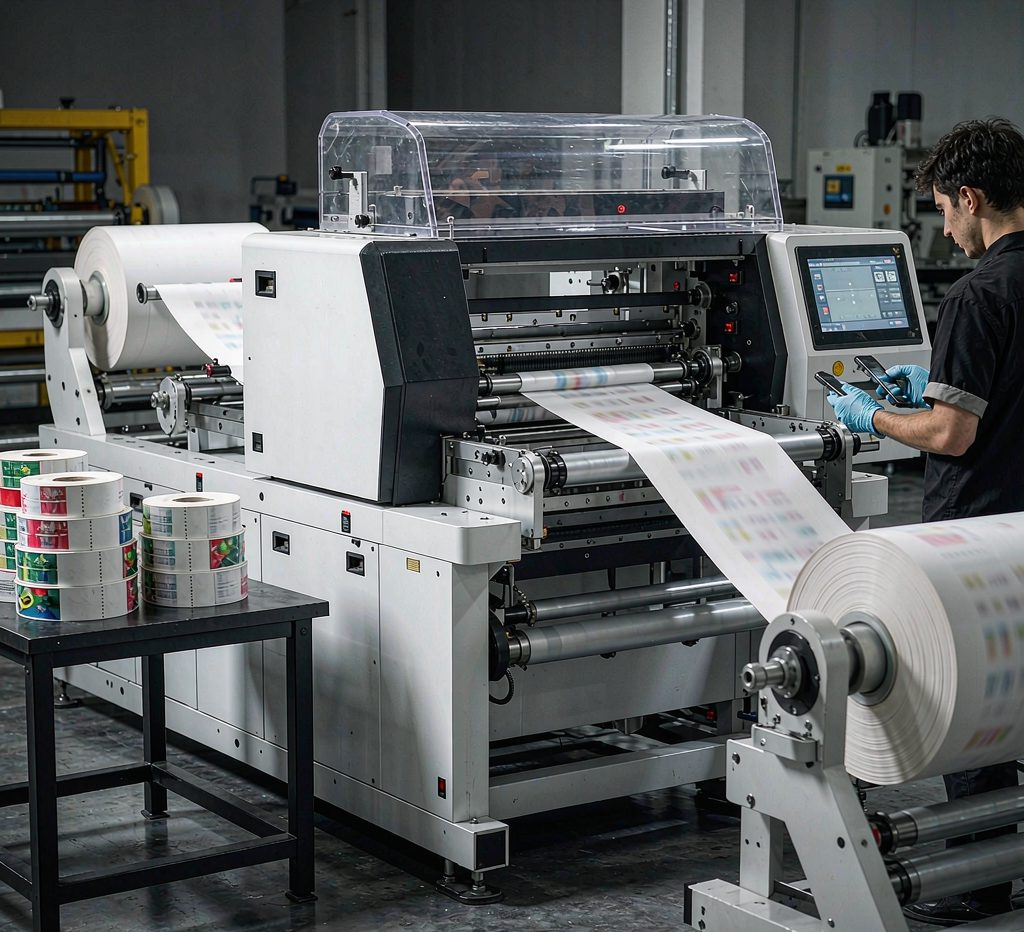
On a five hundred piece order the material may be a few dozen yuan while plates and make ready run into the hundreds. Divide and the unit price explains itself.
Digital changed the structure
Digital label presses need no plates, bill per impression, and need only self-check and colour calibration to start, so short runs behave nothing like conventional printing. At five hundred or a thousand pieces the unit price is far lower and lead time is shorter. The trade-off is that digital does not scale down at volume, and material choice is restricted because not every face stock and adhesive is qualified.
Hence the usual split: short runs, multiple versions and variable data go digital; single versions, high volume and special materials go conventional. If a supplier runs both, ask which is cheaper for your quantity rather than assuming.
Actions that cut the price immediately
Reduce colour count. Four colours down to two halves the plate bill. Use an existing die. A new cutting die costs several hundred yuan, and a standard size die already on the shelf removes that line entirely. Combine batches. Three small orders produced together share one make ready. Lengthen the roll. Total quantity is the same but fewer rolls means less changeover waste. And loosen the delivery date, because fitting into a gap in the schedule sometimes earns a better price.
Do not over-order to chase a unit price
This is the other common mistake. Adding an order from five hundred to five thousand to spread the plate cost does lower the unit price, but labels have a shelf life. Sealed stock kept dark below 25 degrees Celsius and around 50 percent humidity holds for 6 to 12 months, after which adhesive migrates and face stock distorts. Whatever is left over gets sold as waste paper and the saving goes with it.
The right quantity is about half a year of usage. If it will be consumed within six months, order up. If not, order small and accept the higher unit price. That arithmetic is clearer than a unit price comparison.
Three numbers to ask for
Before comparing quotes, ask for three figures: plate cost, make ready cost and minimum order quantity. With those three clear, you can calculate what the unit price becomes as volume rises and judge whether another supplier would be cheaper. A quote that returns a single total without a cost breakdown cannot be compared at all, because you cannot tell whether the expensive part is one-off or charged on every piece.
Getting those three numbers in writing is worth more than another round of negotiation, and it exposes the cost structure faster than switching suppliers.
Order the quantity you will actually use, not the quantity that makes the unit price look good.