

Industrial Labels for High-Temperature Applications
What temperature actually reaches the label, for how long, and whether it happens before or after application. Three questions that decide material.
In industrial production and process control, self-adhesive labels have long surpassed their mere identification function, becoming the core medium for connecting production, traceability, and compliance. Especially in fields such as healthcare, electronics, and food, where label durability is highly demanded, the temperature resistance, friction resistance, and chemical corrosion resistance of labels directly impact production efficiency and product compliance.
Label application in the medical industry always revolves around three core requirements: durability, clarity, and traceability. Scenarios such as hospital pharmacies, equipment production workshops, and sterile wards impose far stricter requirements on label stability than ordinary industries—high-frequency alcohol disinfection, long-term exposure to liquid medicine, and strict sterility control all pose severe challenges to labels. Many medical institutions and healthcare enterprises have found in their actual operations that conventional labels are prone to blurring of handwriting, warping of edges and corners, and even label detachment due to material intolerance after repeated wiping with alcohol. This not only affects the diagnosis and treatment process but may also compromise traceability due to missing information.
In industrial production scenarios, the durability of labels is directly related to production efficiency and product quality. Taking the production of electronic components and automotive parts as examples, labels must withstand multiple challenges such as high temperatures, oil contamination, and mechanical friction. Ordinary paper labels or conventional adhesives are prone to failure under conditions such as high-temperature baking and chemical cleaning, leading to issues such as label detachment and information blurring, which increase rework costs.
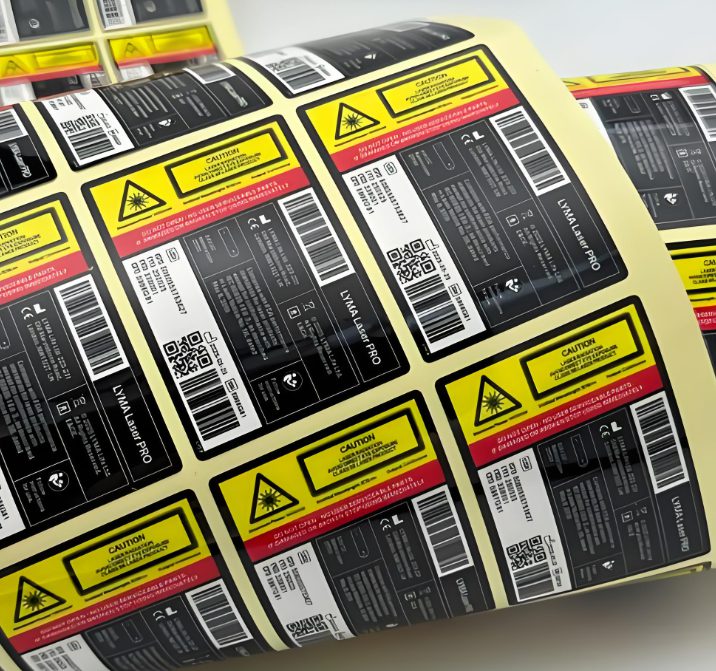
Choosing the appropriate label material and craftsmanship is the key to addressing pain points in various scenarios. PET surface material, with its excellent temperature resistance and toughness, has become the preferred choice in industries such as healthcare, electronics, and automotive. Its surface is smooth, resistant to friction, and not prone to deformation. When paired with specialized high-temperature adhesives, it maintains stable adhesion within a temperature range of -40°C to 150°C. Even under extreme conditions such as high-frequency sterilization and high-temperature baking, it can firmly adhere to the surface of packaging or equipment.
The choice of printing process also affects the durability of labels. Resin ribbon printing combined with PET surface material can effectively prevent ink from peeling off, ensuring that label information is clear and legible. Laser engraving technology further enhances the resistance to friction and chemicals of labels, making them suitable for special scenarios such as medical disinfection and industrial high temperatures, and meeting information traceability and compliance requirements.
Compliance is the bottom line for label application, especially in industries such as healthcare and food. Labels must fully present core content such as product information, manufacturer, and traceability codes to ensure they can be traced and verified. Many companies have failed to pass regulatory audits due to neglecting label compliance, or incurred unnecessary losses due to vague label information affecting traceability.
In practical industry operations, label failure often stems from improper selection—such as using ordinary paper labels in high-temperature scenarios or failing to adopt alcohol-resistant and friction-resistant printing processes, ultimately leading to label detachment and information blurring. The correct selection logic should be based on the needs of the scenario: for high-temperature disinfection scenarios, it is preferable to use PET surface materials paired with dedicated high-temperature adhesives; in fields such as healthcare and food, where hygiene requirements are high, food-grade inks and environmentally friendly materials should be selected to avoid chemical residues.
From the perspective of industry trends, the application of self-adhesive labels has evolved from basic identification to functionality, compliance, and practicality. Whether it is in high-frequency disinfection scenarios in the medical industry or in high-temperature and oil-contaminated environments in industrial production, the durability and information integrity of labels directly affect process efficiency and product reputation. Choosing label materials and processes that are suitable for the specific scenario is essential to truly leverage the value of labels and avoid cost waste and process delays caused by improper selection.
In today's era where automated production and intelligent control are becoming increasingly prevalent, labels serve not only as information carriers but also as a crucial component in ensuring process compliance and enhancing production efficiency. Emphasizing the scenario adaptation and performance upgrade of labels is essential to enable them to truly serve production, distribution, and supervision, thereby becoming a vital support for the high-quality development of enterprises.