

Tire Vulcanization Labels: Surviving 160°C in the Mold
Tire labels go into the mold with the green tire. Stock, adhesive and barcode contrast have to survive 140-170°C and still scan afterwards.
A tire sidewall label goes into the mold with the tire. The building line applies it to the green tire, the press closes, heat and pressure come up, and somewhere between ten and forty minutes later the label has become part of the sidewall. For a pressure-sensitive construction this is a brutal duty cycle: 140°C to 170°C, mold pressure of roughly 1.5 to 2.5 MPa depending on size, rubber flowing underneath, compound crosslinking all around it.
Face stock comes first
Standard label stock starts to fail around 80°C, long before the mold reaches temperature. Vulcanization labels move up a tier. High-temperature PET is the common choice and handles roughly 150°C. Polyimide film goes past 250°C at a noticeably higher cost. Coated fabric, usually a treated nylon, sits between the two and conforms better to the curved sidewall.
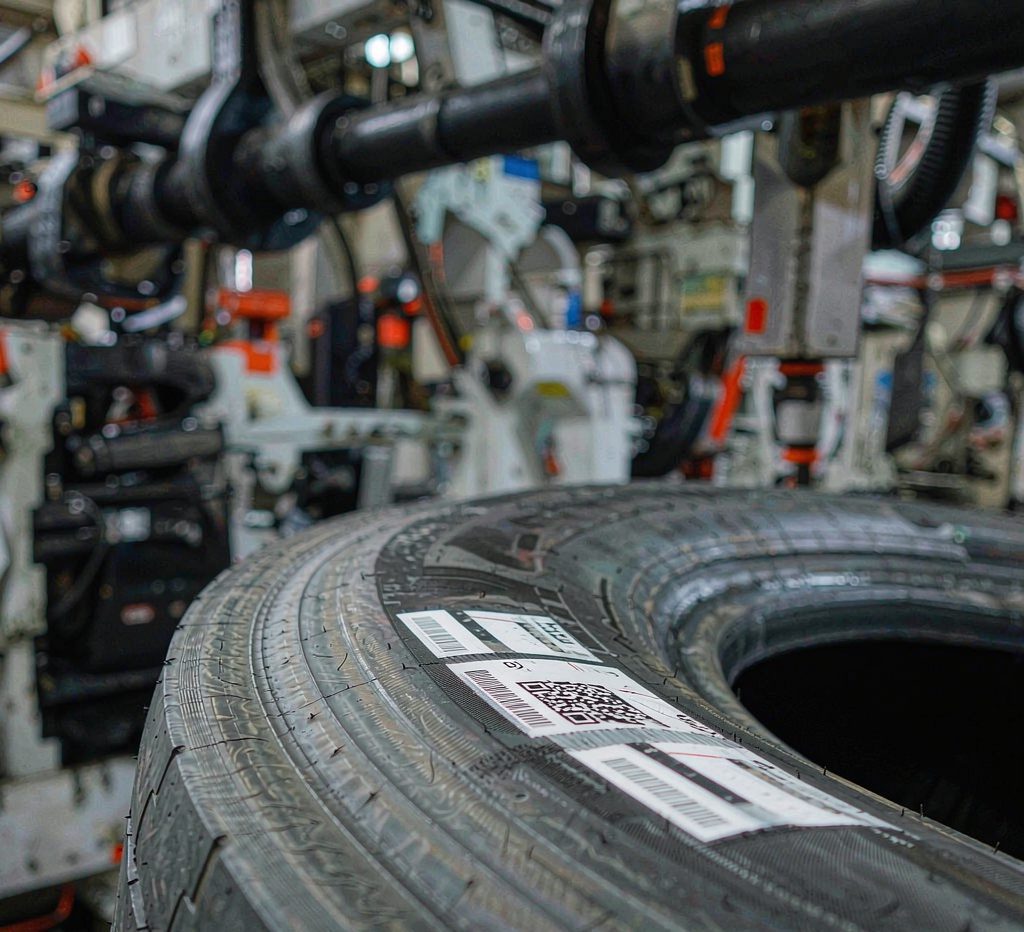
The decision should follow the actual cure curve rather than the peak number. Ramp rate, dwell time and cooling all change how a given face stock behaves.
The adhesive is the other half
Most vulcanization labels do not use ordinary pressure-sensitive adhesive. They carry an uncured rubber layer that crosslinks with the tire body during cure, which is why the label ends up bonded rather than stuck. That layer has low tack at room temperature and relies on the mold cycle to develop the bond. High-temperature acrylics are the alternative: easier to apply, less forgiving on curvature.
Printing and reading
Typical content is a production week code, plant code, size designation and a QR code for traceability. Thermal transfer with a resin ribbon is the mainstream route, usually finished with a protective top layer so rubber flow does not drag ink off the surface. Screen printing with a dedicated ink and a high-temperature cure is also used where long-term weather resistance matters more than cycle time.
Give the QR code margin. Rubber moves in the mold and can push against the label edge, so a module size that looks fine on paper can lose grade after cure. A practical approach is to size modules one step above the finished requirement and keep the code away from the tread transition zone. After cure, pull samples and grade them to ISO/IEC 15416. C level, which is 1.5, is usually the floor, and A or B is where you want to be.
Two failure modes people miss
Adhesive squeeze-out is the first. Under heat and pressure the rubber layer migrates past the label edge, and whatever ends up on the mold becomes fouling that costs a shutdown to clean. The right adhesive is the one with a controlled flow window, not the one with the highest tack.
Batch consistency is the second. Vulcanization label failures are rarely total. They show up as one lot behaving differently on one line. Face stock lot variation, coating weight drift and ribbon batch differences all shift the result. Suppliers who keep retention samples of each make root cause work possible.
Plants rarely switch label suppliers over price. They switch after a mold-fouling event, or a run where read rates dropped after cure. Those problems are expensive to chase, so locking down cure profile, adhesive type and read grade during selection costs far less than fixing them later.