

60 Bottles a Minute: Why Labels Fly Off the Line
High line speed exposes release force and web tension problems. Why a label that runs at 30 bpm fails at 60, and what to adjust first.
When a line gets faster, the first thing to fail is rarely the servo on the labeler. It is the moment the label leaves the liner. Labels drift, land crooked, or come off two at a time. Operators reach for the machine settings. Most of the time the answer sits in the material specification.
Flying labels and double feeds are different faults
A flying label leaves the peel plate and is not caught by the wipe-down belt. It sails past the bottle or lands off position. A double feed pulls two labels at once, with the second ending up on the conveyor. They point in different directions. Flying labels usually trace to low release force, static, or peel plate geometry. Double feeds usually trace to shallow die cutting, release force that is too high, or a sudden change in peel speed.
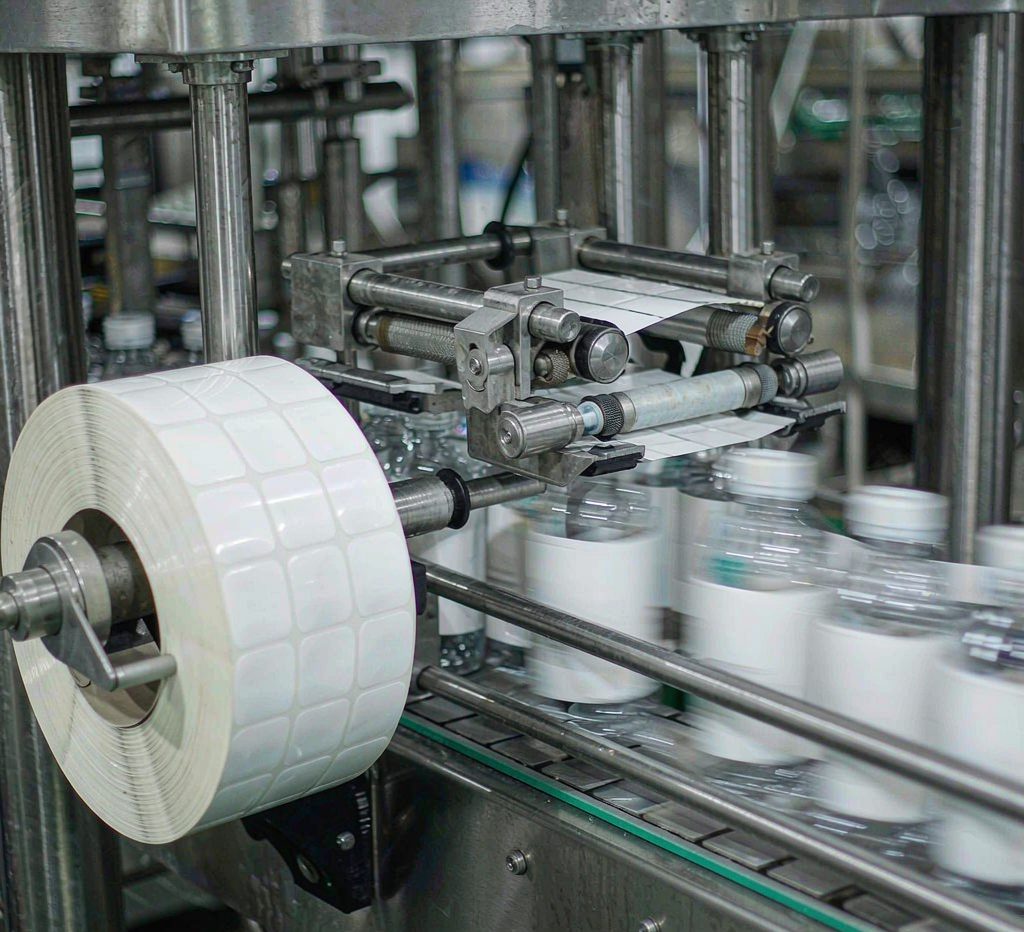
How release force is measured
Release force is reported in grams force per 25 mm, measured at 180° peel and 300 mm per minute, following the FINAT methods most converters use. Hand application and semi-automatic lines feel fine at 5 to 15 gf/25 mm. Once the line passes 30 bottles a minute, 15 to 40 gf/25 mm becomes the working range. Material that is too light will not stay flat against the peel plate and the label springs loose early.
Lower is not automatically better. Buyers sometimes judge a roll by how easily it peels by hand, then wonder why the automatic line throws labels every shift.
Silicone coat weight and die depth travel together
Release force comes from the silicone coat weight. Solvent-based silicone typically runs 0.6 to 1.2 g/m², solventless 0.8 to 1.5 g/m². More silicone means lower release force, up to the point where silicone transfers to the adhesive and stacked labels start blocking.
Die cutting should cut through facestock and adhesive, press into the liner, and stop short of cutting through it. A practical rule keeps at least half the liner caliper intact, with die pressure held within 0.02 mm. Cut too shallow and the waste matrix breaks, raising the double-feed rate. Cut too deep and the liner is scored, which snaps on a high-speed unwind.
Peel plate geometry and plant humidity
A peel plate with too small a radius forces the label through a tight bend. Instantaneous release force climbs, the label gets pulled off rather than fed off, and it lands ahead of target. Most lines settle between 15° and 25° with a wipe belt and vacuum assist holding the landing point on the bottle centreline.
Below 35% RH, static builds up quickly. Labels cling to guide rollers or repel each other in the stack. Label halls generally hold 23 ±3 °C and 50 ±10% RH. In a northern winter, adding humidity fixes more faults than changing material.
Put the numbers in the purchase specification
The information that gets lost is exactly these values. A quotation lists size, material, quantity, and colours. Release force and coat weight are absent. Change suppliers and every machine setting has to be rediscovered.
For high-speed accounts, three lines belong in the technical specification: release force range, rated line speed, and die depth reference. With those on paper, a new batch can be compared against the last one, and a fault can be traced to material drift or to worn tooling instead of guesswork.
If line speed went up and the labels did not change, resist the urge to add vacuum. Pull a roll of new stock, pull a roll of old stock, and measure release force on both. The difference usually explains everything in a single test, and saves the two or three days normally burned on trial runs.