

Labeling at Minus 18: Adhesive and Stock Must Change
Applying labels to frozen surfaces needs a freezer-grade adhesive and enough application pressure. Standard glue turns glassy and never wets out.
A label that applies perfectly in a warm workshop falls off the moment it is used at minus eighteen degrees. The adhesive is not faulty. It is hard.
Why adhesive stops sticking in the cold
Pressure sensitive adhesive works by deforming under pressure, flowing, wetting the surface and then holding through intermolecular forces. As temperature falls, the polymer chains lose mobility, and near the glass transition temperature the adhesive turns from rubbery to glassy. It behaves like a thin sheet of plastic: it touches the surface but never wets it. Common permanent PSAs have a glass transition around minus twenty degrees Celsius, and formulation moves that number a long way either direction. In a cold store the adhesive sits close to that region and initial tack collapses.
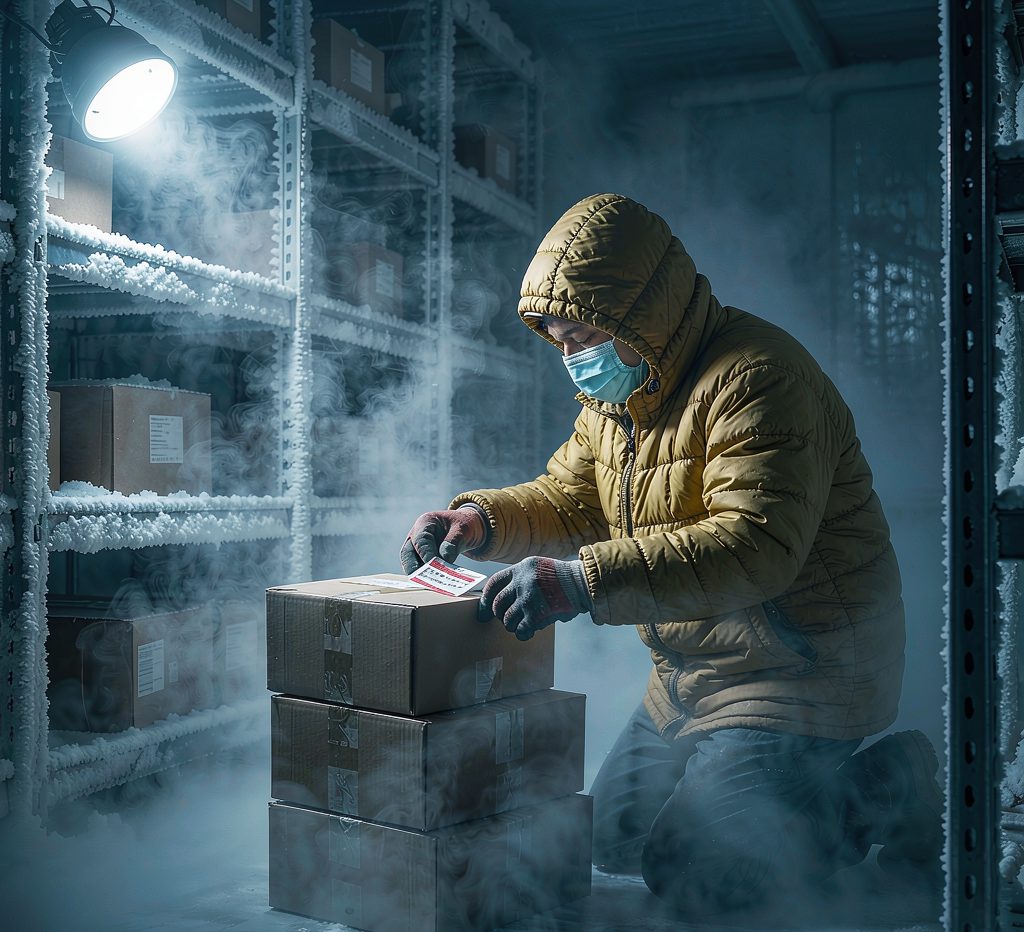
There is a second effect. The product itself is cold, so the moment the label touches it the adhesive layer is chilled further, removing whatever mobility it had left.
Three conditions, all required
Product temperature first. Standard cold store practice is to bring goods out to a buffer area until the surface reaches at least 5 degrees Celsius, apply there, and then return the goods to storage. Without that, even a good adhesive is relying on luck.
Adhesive type second. Deep freeze grades shift the glass transition downward by adjusting tackifying resins and softening point, commonly covering minus twenty degrees or lower while retaining some initial tack. These adhesives tend to be softer at room temperature, and they cost meaningfully more than standard permanent grades.
Surface condition third. Cartons and film in a cold store carry a film of frost or condensation, and adhesive applied over that bonds to water rather than to the material. The surface has to be wiped or air blasted. Applying onto frost defeats any adhesive made.
Face stock gets brittle too
Paper loses moisture in the cold, turns brittle and cracks when bent, especially over a carton corner or around a cylinder. Synthetic paper and PET stay far more flexible at low temperature and are the safer choice for deep freeze work. Paper also shrinks dimensionally in the cold, so a die cut label can sit slightly smaller than designed, which matters where placement accuracy is tight.
Do not skip the settling period
Goods coming out of a cold store condense moisture on the surface, which makes hand application harder rather than easier. The disciplined sequence is to label, then hold for at least 24 hours before the goods go back into the cold, so the adhesive can wet out and build final bond strength. Shipments rushed straight back into storage tend to shed labels in bulk a few days later on the shelf.
Put the operating temperature into the specification rather than the words low temperature. State the product temperature at application, the storage temperature and how soon after labelling the goods return to the cold, so the supplier can match an adhesive instead of guessing.
The packaging changes as well
Carton board loses moisture in a cold store, its surface turns rough and fibrous, and the real contact area for the adhesive shrinks compared with room temperature. Shrink film hardens in the cold, stops conforming, and the label edge lifts. That makes cold store application harder in practice than in a lab test, so specify with a margin instead of using the data sheet to its limit.
Ask the supplier what temperature the adhesive was qualified at, and add ten degrees of margin to whatever answer comes back.