

Why Labels Wrinkle First in the Middle of Squeeze Tubes
Squeeze tubes deform under grip, and the label has to follow. Film face stock, soft adhesive and correct tension reduce middle wrinkling.
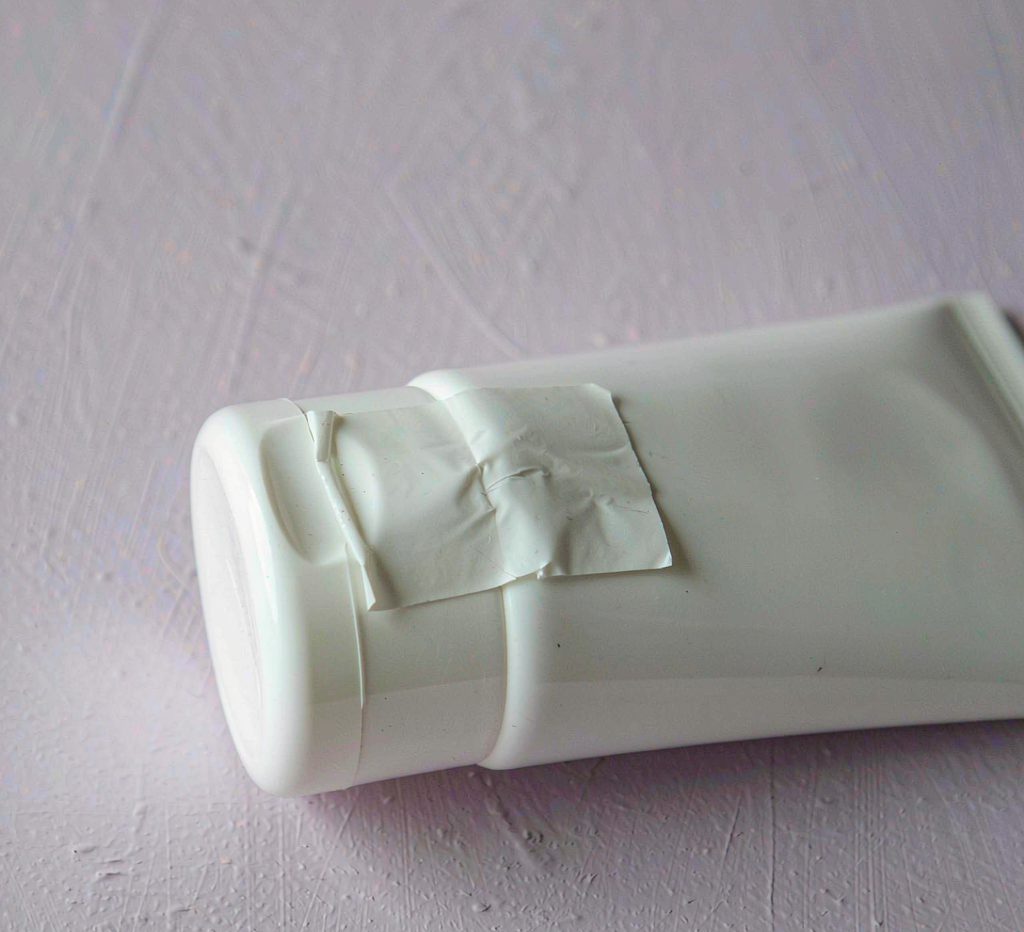
A hand cream tube is labelled, passes outgoing inspection, and two weeks into use the customer reports fine wrinkles across the middle of the label and lifted edges. The tube is intact and the adhesive has not failed. The label simply cannot follow the tube as it deforms.
How much a tube actually moves
A typical PE tube has a wall of 0.3 to 0.5 millimetres, and squeezing reduces the body diameter by 5 to 10 percent before it springs back. The recovery is incomplete, so repeated squeezing accumulates permanent deformation. Near the crimp seal the material also goes through heat and pressure during filling and sealing, leaving that band in a different state from the body.
That range exceeds what paper can do. Coated paper typically elongates 2 to 5 percent before breaking and PET film less, while the middle of a tube asks for more than 5 percent on every squeeze. When the face stock cannot follow, the adhesive layer has to absorb the movement, and once shear stress exceeds what it can carry, the wrinkles appear.
Why the middle fails first
The middle is where the hand grips, so it deforms most and most often. There is also a second effect: during labelling the tube is held open on a mandrel, the label goes on while the tube is expanded, and when the mandrel releases, the tube contracts and puts the label into compression. The edges lift first and the wrinkling spreads inward. Near the crimp the mechanism differs, and the usual cause is sealing heat softening the adhesive while the label is pulled.
Choosing the face stock
Following the deformation means choosing a soft, high elongation stock. Soft PE face material is the best answer, stretching well beyond 200 percent and moving with the tube. Thin synthetic paper comes next but has limited elongation and only suits rigid or low movement tubes. Stretch film labels and elastic specialty films also work.
Coated paper is the worst choice. It is cheap and prints beautifully, yet on a squeeze tube it will wrinkle almost regardless of the adhesive, unless the tube is rigid aluminium or an ABL tube with minimal movement. Ask for the tube material and wall thickness before specifying anything, and the answer usually follows.
The adhesive matters just as much
Three properties at once: high initial tack so it grips immediately, high cohesion so repeated shear does not make it flow, and enough flexibility to move with the face stock. High cohesion rubber or modified acrylic grades are the usual answer, applied slightly heavier than on a conventional label to leave room for movement.
Very soft adhesives are the trap. They grab well but flow under repeated squeezing, migrate out at the edge, and produce squeeze out and a tacky surface, which is worse than the wrinkle you were trying to avoid.
Two settings on the applicator
The mandrel. Tube labelling needs an inflatable or segmented mandrel so the body stays close to round during application and is released afterwards. A rigid mandrel forces the tube into a polygon and the label goes on with creases built in.
The position. Keep the label toward the upper body, away from the lower middle where squeezing concentrates and away from the heat zone at the crimp. Designs that wrap the label over the whole tube look generous on a mock-up and raise the wrinkle risk sharply.
How to test acceptance
A static sample shows nothing. Simulate use instead: squeeze the labelled tube fifty times to about one third of its diameter, then leave it 24 hours and inspect. A pass shows a flat surface, no lifted edge and no more than one faint crease. That takes five minutes and costs far less than discovering it at the customer.
One more check gets skipped: re-inspect seven days after filling. Some adhesives change once in contact with the contents or once under load on a shelf, and the seven day point catches that before it becomes a complaint.