

Release Liner: The Layer Everyone Throws Away
Every label leaves a liner behind. It is a real share of label cost, and it is getting thinner and, in some cases, reusable.
A carton of labels runs out and the bin fills with backing paper. It is never on the product and nobody sees it, yet every sheet of it is paid for.
What the liner actually does
A pressure-sensitive label has three layers: face stock, adhesive, liner. The liner carries a silicone coat so the adhesive will not bond to it, which is the only reason a label can be peeled off at all. How much silicone goes down, and how evenly, sets the release force. Too low, and labels fall off the roll during shipping or die cutting. Too high, and the peel plate cannot lift them, so the label stretches or tears.
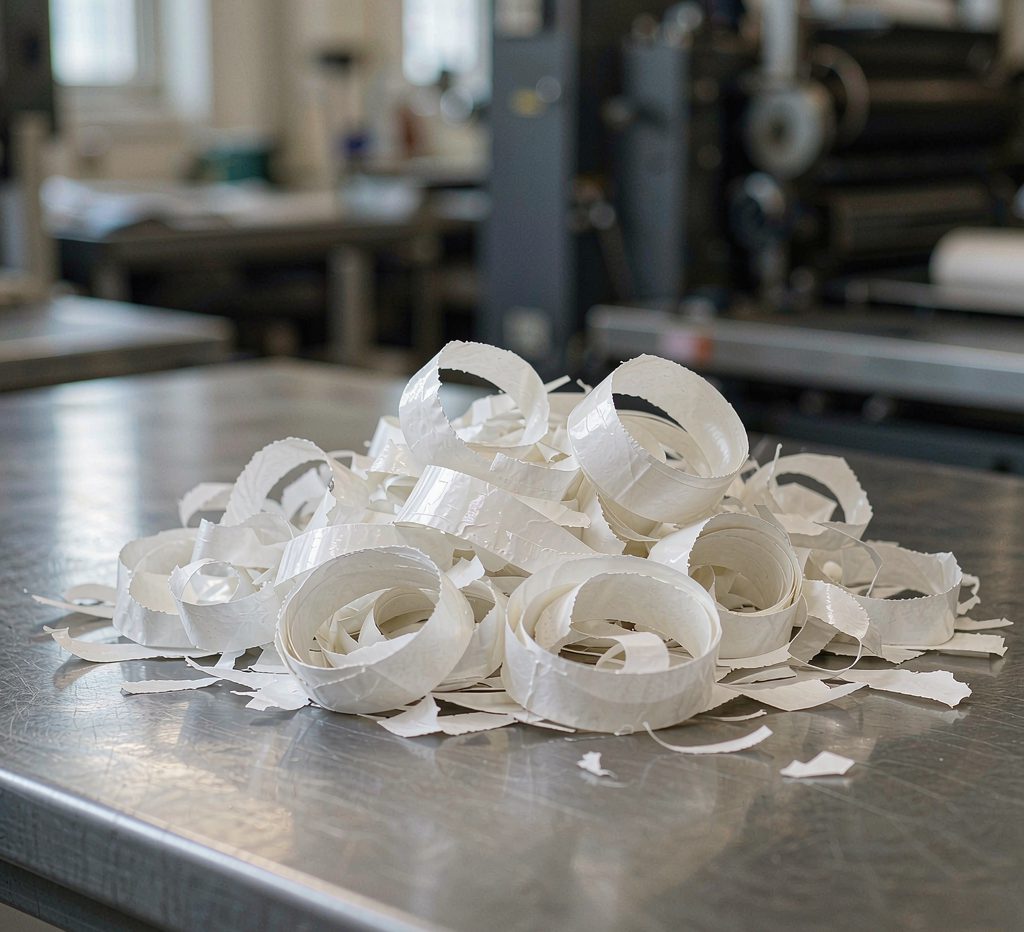
The liner also has to be stiff. On a labeling machine the web travels several meters over rollers before it reaches the peel plate. A liner that is too soft wrinkles or tracks off center, and labels land in the wrong place. Stiffness shows up on a data sheet as tensile strength, but whether a liner works is only settled by running it.
Sixty grams down to forty
Glassine liners used to run eighty or sixty grams per square meter. Many now sit near forty. The saving is paper and freight, and a roll of the same diameter holds several hundred more meters, so operators change rolls less often and the line stops less.
The cost shows up in stiffness and die cutting. Thinner paper has lower tensile strength, so a machine with loose tension control will snap the web. Die cutting has less margin before the blade cuts through the liner, and when it does, the matrix pulls labels away with the waste. Moving to a lighter liner usually means re-setting die pressure and rewind tension, not just loading the roll.
For a fixed roll diameter the length you can wind is inversely proportional to total material thickness. Take a fifth off the thickness and you get roughly a quarter more length on the same core. On a line that changes rolls a dozen times a day, that turns straight into downtime.
Film liners
PET liner does not absorb moisture, holds its dimensions, and has far tighter thickness tolerance than paper. High-speed labeling and fine die cutting run steadier on it. It can also be collected and reused: once labels are applied the spent liner winds back up and goes to a converter that cleans and re-silicones it, and it survives several cycles. The drawbacks are price and slipperiness, which makes tension control harder.
What to check before switching
Line speed first. Hand application and a line running dozens of bottles a minute ask completely different things of liner stiffness. Then label size. Small labels on tight layouts already have little die cutting margin, and a thinner liner pushes reject rates up.
Then look at where the waste goes. Paper liner has almost no recycling path in most regions and ends up as general waste. Film liner is expensive, but some plants already collect it because a clean PET stream has value. If a customer has to report packaging waste, the liner is one of the first items that gets questioned, and it is usually a surprise.
One more point: the liner is only half of the release system. Silicone that has migrated to the face side of a sheet, or adhesive that has crept to the edge of the roll, produces the same symptom as a liner that releases too hard, and it is easy to blame the wrong layer during a trial.
When Huaishi sends samples, a length of the same liner batch goes with them so the customer can run it on their own machine before committing. That beats reading a data sheet.