

In-Mold Labels vs Pressure-Sensitive: Where the Line Falls
In-mold labels form with the plastic part, so lifting, edge curl and water ingress cannot happen. The limits are real, and only large runs clear them.
Plastic pails, yogurt cups, detergent bottles: a growing share of the graphics on those containers is not applied afterwards, it forms with the plastic. The process is in-mold labeling, and it has taken work that used to belong to pressure-sensitive labels. Only part of it, though.
It solves the familiar failures
A pressure-sensitive label on plastic struggles with three things: poor grip, edge curl, water ingress. Low surface energy PP and PE containers need treatment, edges lift in cold chains and damp storage, and products that get wet for long periods risk water creeping under the adhesive from the edge.
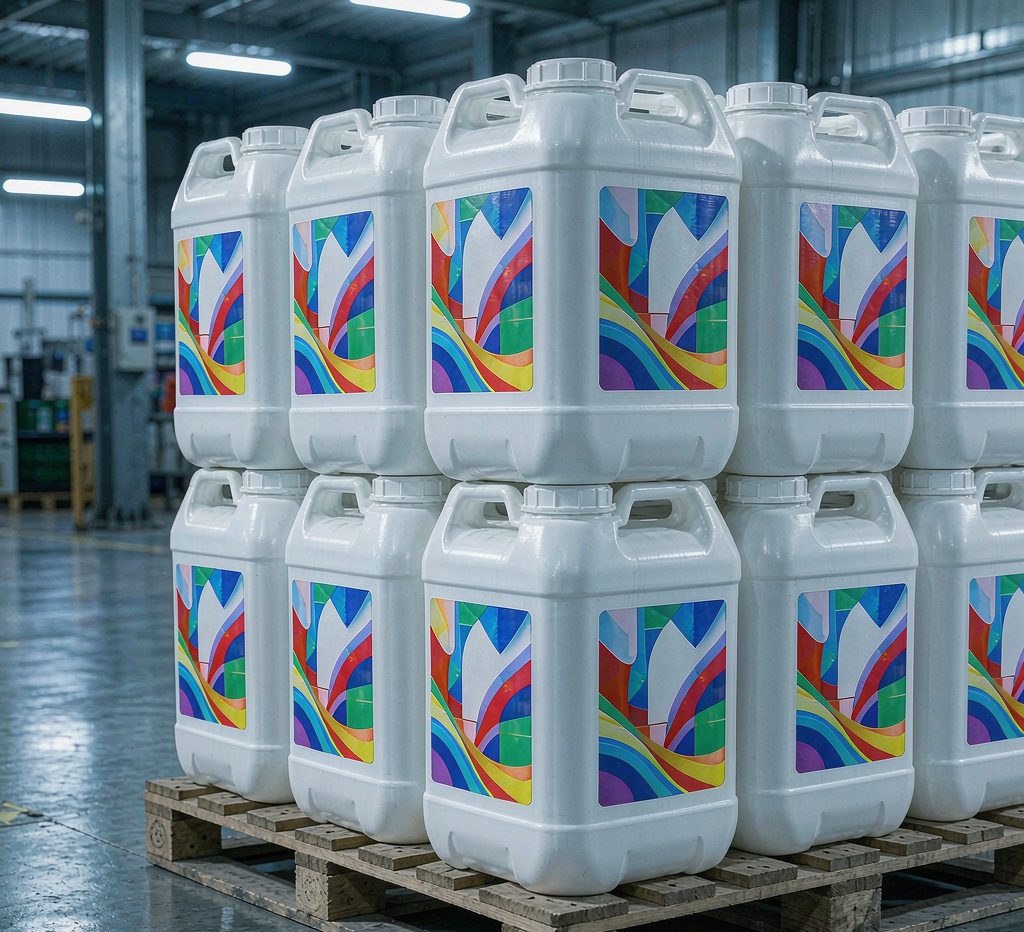
In-mold labeling makes the label and the part one piece. The label becomes part of the plastic surface, with no adhesive and no edge, so there is nothing to curl and no path for water. The print sits under a clear layer and survives scrubbing and soaking. At end of life the part is a single material, which is easier to recycle than a plastic container carrying a paper label.
Where the cost sits
The cost structure is completely different. In-mold needs dedicated tooling, labels pre-cut to shape and placed in the cavity by static charge or a robot, and start-up scrap while the process settles. Those fixed costs barely move with order size, so the per-unit figure for twenty thousand parts and for two hundred thousand are far apart.
The barrier is therefore volume, not technology. A single product with a settled shape and no redesign for years can push per-unit cost below pressure-sensitive while looking better. A product running a few tens of thousands a year, or changing artwork every quarter, will never recover the tooling.
Where pressure-sensitive holds
Many variants in small runs is the first. One bottle in fifteen flavors at a few thousand each, with frequent artwork changes, breaks the in-mold economics; a pressure-sensitive line just changes the roll.
Complex shapes is the second. Deep recesses, tight curvature and handles leave no room to place a pre-cut label, or the label will not conform. Those bottles still get labeled afterwards.
Late binding is the third. Some products only settle their label content after filling, after inspection, or after the customer orders, when batch codes, production dates or customer-specific marks are known. That information can only go on afterwards.
Then there is the retrofit problem. Existing filling and labeling lines are built around pressure-sensitive webs. Moving to in-mold means changing the molding step as well, which is not a supplier switch.
Print quality is a wash on both routes. In-mold labels are printed offset or gravure and sit under a clear resin, so the finish looks deep, but the artwork has to be final before molding begins and nothing can be added afterwards. Applied labels can carry late changes, variable data and short codes right up to the run.
Telling which side you are on
Look at three numbers: annual volume per SKU, how often the artwork changes, and how complex the container shape is. High volume, stable artwork and a regular shape are worth quoting in-mold. Fail any one of the three and pressure-sensitive is simpler.
Plenty of brands run both. The flagship product goes in-mold, seasonal and regional editions get labeled afterwards. That mix is increasingly common in beverages and personal care.
Huaishi works on the applied side. When a customer arrives with an in-mold quote to compare against, we usually work through the arithmetic: tooling amortization, start-up scrap and revision costs spread over the units, then the real gap between the two routes. More often than not the line falls on volume, not unit price.