

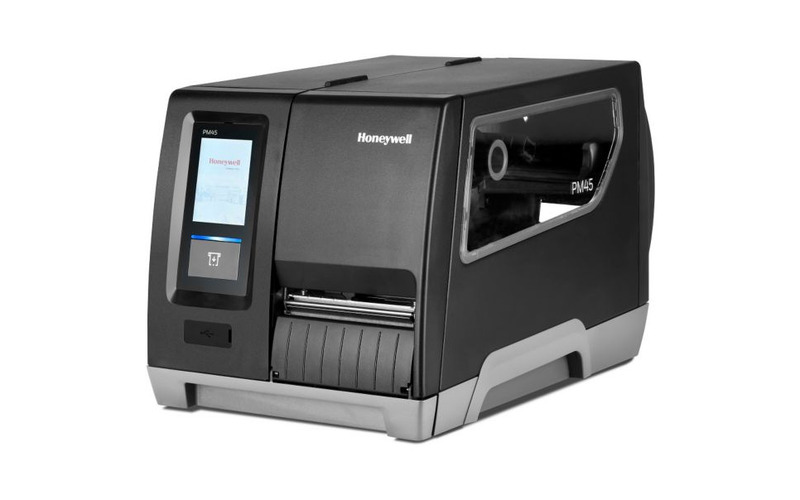
The PM45 is the precision-focused model in Honeywell's industrial line: +/-0.5 mm positioning accuracy, up to 600 dpi, and still capable of 350 mm/s. Precision and speed are not mutually exclusive here.
Why positioning gets its own number
Print precision is usually described as resolution, but where the print lands on the label is a separate question. Media shifts laterally as it advances. A 1 mm shift sounds small until the label is 20 mm wide, at which point the quiet zone is gone and the code is worthless.
The PM45's +/-0.5 mm applies to positioning across the label. Combined with 600 dpi, small high-density labels yield a high pass rate: component markings, medical device labels, precision part traceability codes.
Applicator interface
An optional applicator interface connects directly to automated labelling lines. A robot arm or pneumatic head takes the printed label and applies it to the product with no manual step.
For automated lines this is not optional. Pairing a standard printer with a third-party applicator means signal timing has to be matched by hand, and mismatches print a label that never gets applied. A factory interface has the timing and signal definitions matched already.
Connectivity
The interface list is unusually complete: two USB host ports, Ethernet, RS-232, parallel, industrial, applicator, RFID, WWAN, Wi-Fi and Bluetooth 5.0. Practically every connection type is available.
WWAN is rare and serves sites without plant networks: field operations, mobile lines. You may never use it, but competitors often cannot offer it.
PM45 or PX45
Both are 4-inch industrial machines. The PM45 wins on positioning accuracy and 600 dpi, suits high-precision dense labels, and supports applicators. The PX45 emphasises the smart printing platform and 406 dpi, with in-printer programming.
A simple test: if the smallest character is near the limit of legibility, or an applicator applies the labels, choose the PM45. If business logic should run inside the printer after a scan, choose the PX45.