

Why Labels Lift on Corrugated Boxes, Surface First
Corrugated board and woven bags are uneven, hygroscopic and moving surfaces. Edge lift usually starts with the substrate, and the fix is high tack thick coat adhesive.
A label that sits perfectly on a coated carton starts misbehaving on corrugated board: corners lifting, the face wrinkling, the whole label peeling after two days. The first instinct is stronger adhesive, which often makes it worse. The root of the problem is the substrate. Corrugated boxes and woven bags, the two most common shipping packs, are exactly the two surfaces that pressure sensitive labels find hardest.
The corrugated face is wavy, not flat
Under the liner paper sits the fluted medium. To the eye the surface is flat; at contact scale it is a series of ridges and valleys. The adhesive touches only the ridges, the valleys carry no load, and pressing harder just concentrates force into lines. Add the coarse fibres and open pores of linerboard, which rob the adhesive of contact area, and only part of the initial tack is ever used. Edge lift starts at the corners, furthest from the ridges and most stressed.
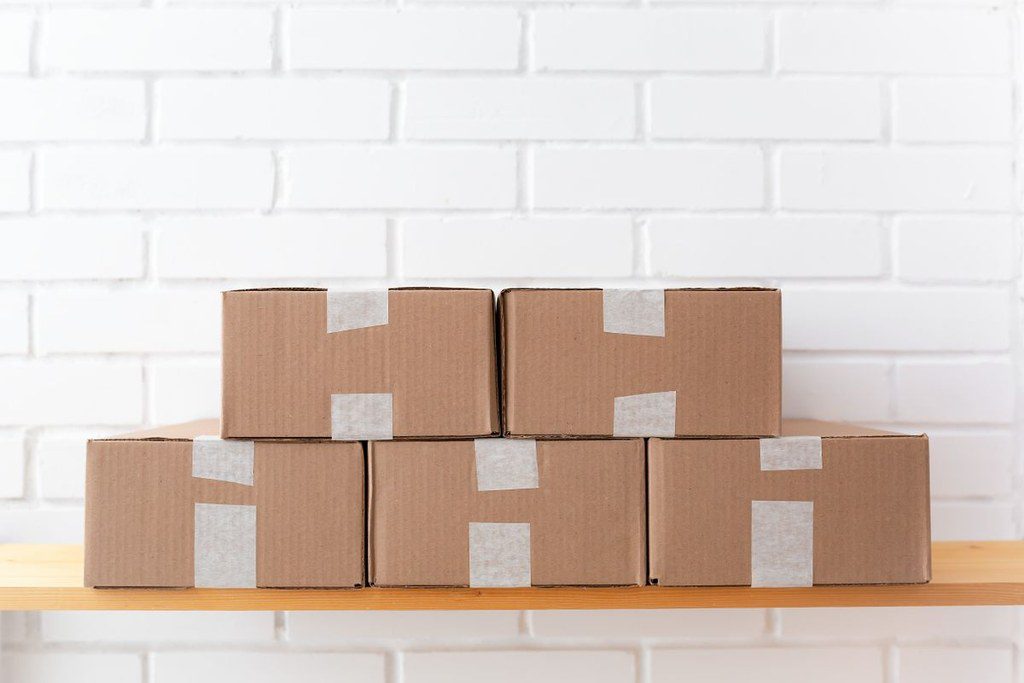
The box also moves
Corrugated board is strongly hygroscopic. When warehouse humidity shifts, the box swells or shrinks, a stress difference opens up between label and board, and the label wrinkles or arches. A filled box is elastic too: stacked weight compresses the face and it springs back, pulling at the label repeatedly. Label after packing and before palletising, and do not cover the entire panel. Leaving a margin gives the board room to move without dragging the label off.
Woven bags are the opposite extreme
A woven PP surface is slick and often dusted with anti slip powder that ordinary adhesives cannot grip, and the bag itself flexes throughout handling, so a hard adhesive releases in sheets. These cases call for a soft adhesive system with high initial tack and a heavy coat, one that penetrates the weave instead of floating on it. Pass a roller over the label after application to work the adhesive into the texture.
Choosing the material
The adhesive direction is clear: high initial tack, heavy coating. A corrugated face does not need maximum permanent tack, it needs instant grab on a coarse surface and enough body to fill the pores. Keep the face stock moderate: a thick, stiff label lifts more readily on a moving box than a medium weight paper or a soft film. A slightly larger label helps too, more contact area means fewer single points of failure. When Huaishi works on shipping pack labels, the routine is to request real boxes and bags, apply samples, and record edge condition over two days at the actual temperature and humidity before fixing the material. Choosing from a datasheet alone often pairs a carton adhesive with a plastic bag surface.
Three points of application practice
Acceptance testing on these surfaces is simple and worth doing on every new specification. Apply five labels to real boxes and real bags. Record the ambient temperature and humidity. Check the edges at two hours, again at twenty four, and again after a week on the warehouse rack through one humidity cycle. Then peel one label slowly and look at where the failure sits: adhesive pulling cleanly off the surface means the bond never formed, fibres tearing with the label means the bond outperformed the board, and adhesive left in the weave means the system is matched. Photograph the corners at each check. That record settles disputes with either the box supplier or the label supplier in minutes, because each failure mode points at a different party.
Timing first: label once the box is packed and the environment stable, and let condensation disappear on boxes out of the chiller. Placement second: keep off the flute seams and the sealing tape, the two least even areas. Pressure third: work the label from the centre outwards with a roller or palm after application, instead of sticking and walking away.