

Why Bottle Seal Labels Lift at the Cap Edge
A seal label that spans the cap and the shoulder sits on a curved surface. Most lifting comes from die-cut misalignment or adhesive that stiffens in the cold, not from weak glue. Three checks in order: measure the neck, verify die concentricity, then review application pressure and temperature.
A bottle seal label lifts at the edge because it has to cross the curve between the cap and the shoulder. On a flat surface the label lies down; on that shoulder the middle never gets pressed home, so the edge works loose first.
Work in this order: measure the neck and the label position, check that the die cut is concentric with the neck, then look at application pressure and temperature. Reverse the order and you will keep changing adhesive without fixing anything.
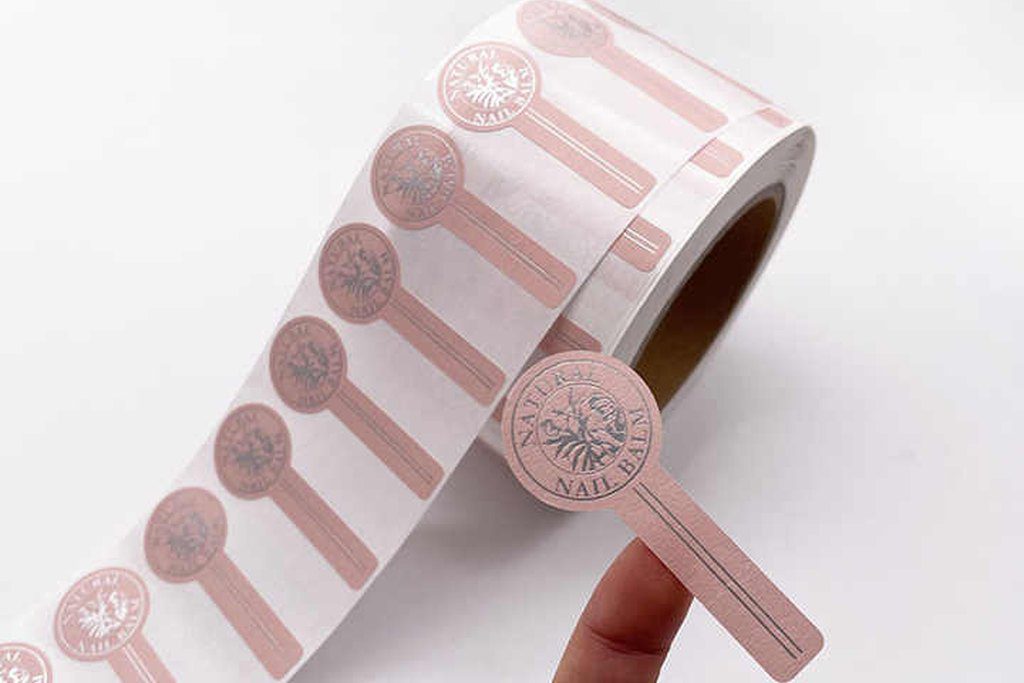
What makes a seal label different
A seal label spans the gap between cap and body and leaves a mark once it is opened. It has to prove the bottle was never opened, which sets two requirements: the facestock must follow the shoulder curve, and the label must break in a controlled way when peeled.
That drives the construction. Soft facestock that can bend over the shoulder, adhesive that grips PET, glass and aluminium caps, and a die cut aligned to the neck rather than to the label outline.
Three types, three failure modes
| Type | Construction | Typical neck range (mm) | Common failure |
|---|---|---|---|
| Die-cut tear line | Bi-directional cuts, paper or holographic film | 18-38 | Lifts along the cut line, tears unevenly |
| Perforated tear | Dense half-cut perforation | 20-45 | Edge fuzz, holes stretch |
| Holographic tamper evident | Holographic film with pressure-sensitive adhesive | 25-60 | Film too stiff to conform, edge springs back |
Those ranges are common bands only. Measure the actual bottle and confirm with a proof; a straight-sided bottle and a sloping-shoulder bottle of the same nominal diameter are not the same job.
Measure the neck before blaming the adhesive
Three measurements matter: neck outer diameter, the radius at the shoulder transition, and the offset between label centre and neck centre. The first two decide how soft the facestock has to be. The third decides whether the die cut is off.
If the label centre is more than 1 mm away from the neck centre, the section that crosses the curve is wide on one side and narrow on the other. The wide side has more unsupported material, and that is where lifting starts. Hand application is usually worse than machine application here.
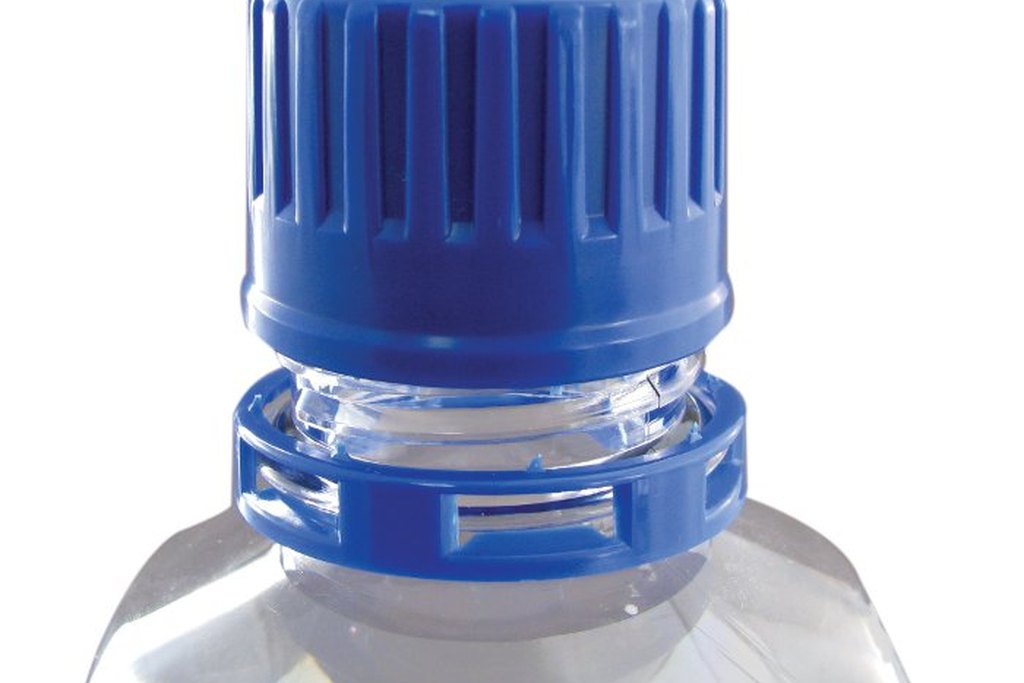
The seal has to bridge the cap skirt and the bottle, and tear cleanly
Check the die cut against the neck
Lay the sheet flat and drop a ring of the same diameter as the neck over it. If the ring and the cut circle do not coincide, the problem is layout or tooling, and no adhesive will fix it.
Two causes show up repeatedly: the layout centres on the label outline while the neck sits off-centre, and the bottle changed while the die stayed on the old version. Both mean the label does not match the bottle by design.
Pressure and temperature
Adhesive on a curved surface only performs when pressure pushes it across the whole contact area. By hand, use a soft squeegee from the centre outward to drive air out. On a machine, fit a curved pad or a compliant backing; a flat pad touches the shoulder along a single line, presses nothing and can crack the cap.
Temperature is the second variable. Below 10 C the adhesive stiffens, springs back after the pad lifts and pushes the edge up. In winter, bring bottles back to room temperature at the sealing station, or specify a cold-weather adhesive rather than retrying the standard one.
Three mistakes worth avoiding
- Switching to a tackier adhesive first: most lifting over a curve is geometry, and tack cannot hold unsupported material down.
- Centring the layout on the label: centre it on the neck instead.
- Using a flat pad on a curved surface: it presses along a line and can crack the cap.
When to proof before ordering
Necks under 20 mm, square bottles with a chamfered shoulder, and any bottle that goes through sterilisation or cold storage should be proofed on the real container. Curvature varies too much to judge from a datasheet.
We are based in Pizhou, Xuzhou and supply low-temperature tamper-evident labels for spirits and sterilisation-resistant labels for pharmaceuticals, both available as bottle-in proofing. Production and inspection run on one line in-house.
Questions we get
It lifts within a day. Is the adhesive poor? Peel the lifted piece and look at the adhesive surface. If the adhesive has transferred cleanly to the bottle, pressure was insufficient. If it stayed on the label, the adhesive does not match the bottle material.
Can glass and PET use the same seal label? Usually not. Glass has higher surface energy, so an adhesive that performs well there may have too little initial tack on PET. Lines running both should stock two specifications.
Why does holographic film lift more? It is stiffer, so it springs back harder over a curve. Reduce the angle that one label has to cross, or move to a softer facestock with stronger initial tack.
Can seal labels be overprinted or laser coded? Paper facestocks accept inkjet; film surfaces need treatment first. Holographic film is generally laser-only. Choose the facestock around the coding method and verify both in the proof.