

Same ink grade, new batch: why solid areas turn mottled
A new supplier or a new batch under the same ink grade can leave dark solids blotchy. Four variables to work through, a fault-to-cause table, and three steps before you switch suppliers.
Same ink grade on the tin, one new supplier, or simply a new production batch, and the dark solid comes off the press mottled: light and dark in patches, as if a haze sat over the sheet. Even a veteran needs both samples side by side under the lamp before calling it.
First decide: uneven film, or wrong shade
Mottle and shade shift are different faults with different fixes.
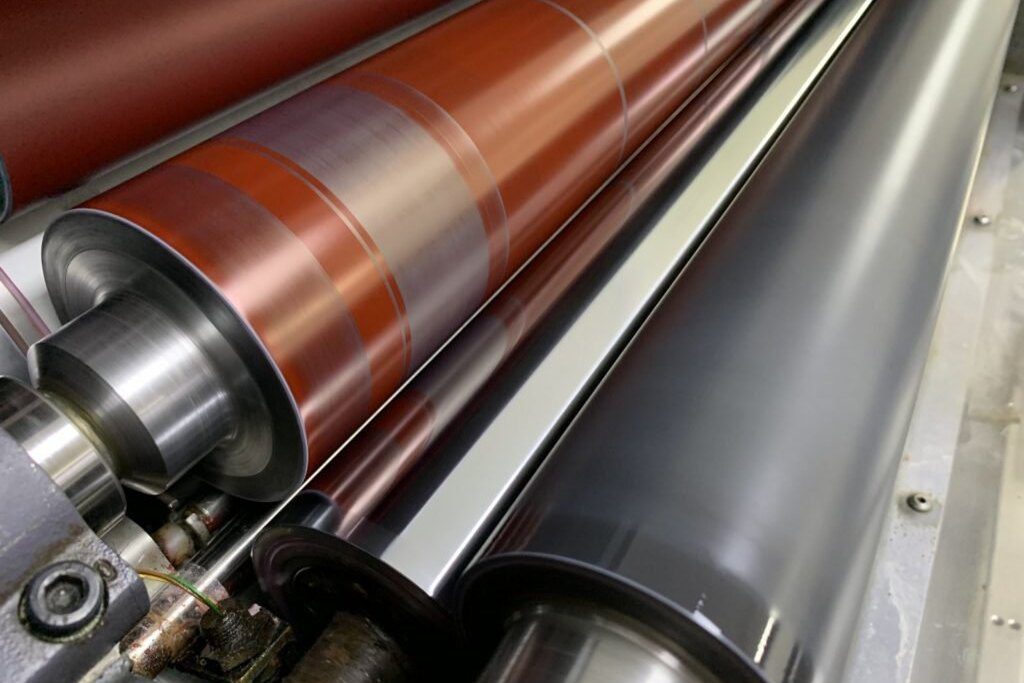
A shade shift moves the whole area one way. Spot-read a few points with a densitometer and the numbers all travel together.
Mottle alternates light and dark on the same sheet, so readings jump. A spread of 0.1 density or more across one solid means film thickness is moving while the colour itself has not changed.
One test settles it: take five readings across a single solid and look at the spread. Tight readings send you to the ink formulation; wide readings send you to transfer.
Four variables a grade label cannot control
An ink grade is a loose bucket. Pigment, resin, solvent, additives: change the source of any one and the label stays the same while the contents do not.
Pigment dispersion. The same colourant milled for a different number of passes gives a different particle size distribution. More coarse particles, less even hiding, patches on the solid. A grind gauge shows this in the lab; the pressroom rarely sees it.
Resin and solvent compatibility. This is where supplier changes bite hardest. Two resin systems do not necessarily blend: they can throw out, coarsen, or separate after two hours in the fountain.
Drying speed. Solvent ratio, shop temperature and airflow decide it together. Too fast and the ink skins before it levels, leaving orange peel; too slow and the rewound roll takes a set, and the next morning the web is fogged.
Ink laydown. On the same press, viscosity dropping from 18 seconds to 15 puts another layer on the anilox. Dark solids are the most sensitive thing on the sheet to that one number.
Fault to cause, at a glance
| Symptom | Usual cause | Measure first | Action |
|---|---|---|---|
| Patchy solid, soft edges | Uneven transfer, viscosity swing or blocked anilox cells | Viscosity, seconds on a No. 4 cup | Hold ±1 second, wash the roll at stops |
| Milky haze, hard-edged patches | Face stock surface energy fallen, corona decay or silicone transfer | Dyne level, mN/m | Change batch, or add a corona pass |
| Weak solid, fine dots missing | Drying too fast, ink never levels | Air temperature °C, air speed m/s | Drop 5–10 °C, add slower solvent |
| Fine off the press, mottled next day | Resin migrating into the face coating | Density re-read after 24 hours | Change system, do not chase it with additives |
| Only where four colours overlap | Total ink film too heavy, underlayers wet | Total laydown, g/m² | Cut 5–8 percent, or drop screen ruling |
The figures are field ranges. Every press and every stock differs, so check them against your own samples before relying on them.
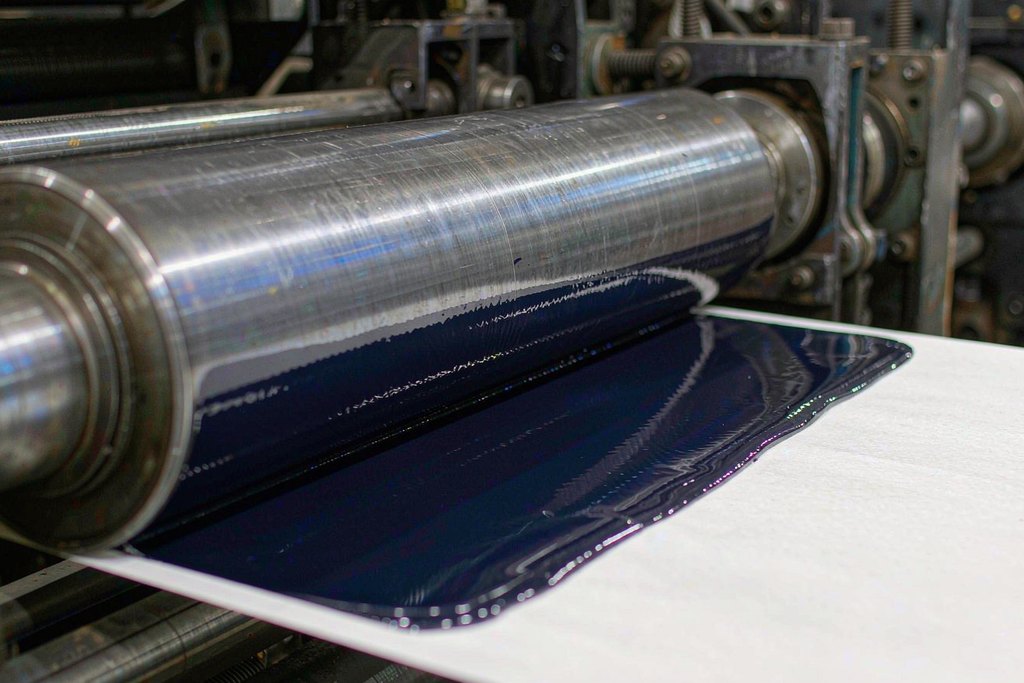
A little more or a little less film, and the densitometer shows it
Working through it, one item at a time
Start with the easiest: viscosity. The same drum can drift two or three seconds between morning and afternoon as the shop warms up. Hold it within one second and half the solid-coverage complaints disappear on their own.
Then the anilox. Dark solids run on fine cells, which are shallow, and a smear of dried ink or paper dust takes that stripe out of the transfer. Pull the roll and look along it against the light: a blockage is obvious.
Third, surface energy. The low-energy stocks in pressure-sensitive work, PP and PE among them, lose their corona treatment over time. A roll that sat in stores for six months commonly drops from 38 to 34 dyne. Skip this measurement and you will blame the ink for months.
Only then suspect the ink itself. Two batches of one grade can match closely on colour and still differ in rheology. To confirm, print a sheet from the retained sample of the old batch. Two hours, one answer, instead of a day of argument in a meeting room.
Three moves before you switch suppliers
One: retain a sample. Before the changeover, seal a tin of the old ink and write the batch and date on it. That tin may save you within the next six months.
Two: print a comparison, on press. Not a drawdown on a bench sheet. Same stock, same line, same settings, two sheets side by side.
Three: re-check after 24 hours. Fresh off the press tells you little. Come back the next day and read density and adhesion again. Migration problems on self-adhesive stock often only appear overnight.
Closing
Ink has been climbing hard this year, with North American price increases announced from mid-December and Asia-Pacific usually following at its own pace. Shopping the supply base is a normal purchasing move. Just do not go to full volume the week you switch.
On a dark solid, one reprint costs far more than the ink you saved. The film on a pressure-sensitive label is two or three microns thick. It looks substantial and tolerates almost nothing.
Print the sample first, then talk price.
Where quotes diverge: identical labels, quotes three tiers apart. How the cost breaks down: cost management arrives in label converting.