Adhesive Labels Expire: Bad Storage Ruins Them in Six Months
Labels stacked in a warehouse corner for a year come out with dead adhesive and brittle liner. Shelf life, storage rules and aging tests, in plain terms.
Labels bought in excess get stacked in a warehouse corner. Six months later they come out with adhesive like dried paste, holding on contact and falling off next morning. This loss repeats every year, and mostly cannot be blamed on the supplier. It is storage failure. Pressure-sensitive labels are chemical products with a shelf life, not stationery that keeps forever.
How Long Is the Shelf Life
The industry norm runs one to two years for adhesive materials kept in original unopened packaging under acceptable conditions, varying with adhesive type and facestock. Water-based adhesives sit at the shorter end, hot melt and solvent adhesives at the longer end. Beyond that window, crosslinking and migration continue inside the adhesive layer, tack declines gradually, and the release force between liner and adhesive drifts.
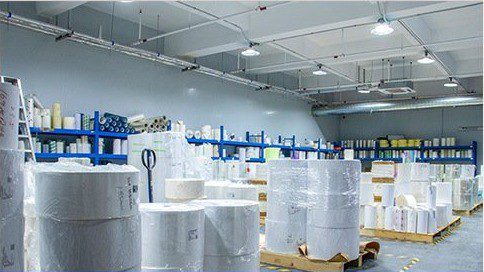
The precondition is the part everyone ignores: original packaging, away from light, dry. Half a roll pulled from its wrap and banded with a rubber band back onto the shelf degrades at more than twice the speed, exposed to air and dust. Ultraviolet is especially hard on certain facestocks and adhesives, and a shelf by the window acts as a slow killer.
How to Store
A few practical rules. First, keep temperatures in the ambient range, away from radiators and sun-heated roofs, and out of cold rooms. Heat-cold cycling expands and contracts adhesive and facestock repeatedly. Second, avoid both extremes of humidity: too dry and the liner embrittles and cracks, too humid and paper facestocks absorb moisture and curl. Third, store rolls standing or stacked flat within a sensible height. Heavy weight deforms and blocks the labels at the bottom of the stack. Fourth, keep the original shrink wrap intact, opening only what will be used. Fifth, the most neglected rule of all: first in, first out. New deliveries stacked on top get used first while older stock underneath quietly expires. This is the most common waste pattern in label warehouses.
How to Judge Aging Stock
Before using labels stored beyond six months, run a simple test. Apply a few pieces to a standard substrate, a carton or a clean plastic surface, then peel one after 24 hours and another after 72 hours. If the 24-hour piece fails to hold, discard the batch. If it holds, and the 72-hour piece shows clear peel resistance and comes off without adhesive residue, the adhesive is still serviceable. Testing the head of the roll is more reliable than sampling the outermost label only, since the outermost wrap ages fastest and the interior often remains in better condition.
Printable labels need an extra look at the liner. A brittle liner with hairline cracks will snap and jam in the printer repeatedly, and that nuisance costs more than the label loss itself.
Advice on the Buying Side
Rather than agonizing over shelf life, keep purchase volumes at a sensible level. Fast-moving standard sizes on monthly replenishment, special sizes produced per order with no stockpiling. When Xuzhou HuaiLion Electronic Technology supplies labels on a running basis, we advise monthly rolling orders for stable specifications. With materials stocked in-house and production scheduled at short notice, the customer's warehouse holds one or two weeks of stock at maximum freshness, and the cash tied up in inventory drops accordingly. Where large-volume stocking is genuinely needed, package by batch, mark the receipt date and always use the oldest first.
Partly used rolls need a rule of their own. Once the outer wrap is cut, the exposed edge picks up dust and loses moisture, and a roll pushed back onto a shelf without being sealed ages much faster than an unopened one. Reseal it in its bag, mark the opening date, and put it at the front of the queue. Simple as it sounds, this single habit accounts for most of the difference between a tidy stores area and one full of half-good stock.
Labels carry a counterintuitive economics: the unit price saved by overbuying rarely covers the loss of one spoiled batch. Buying to demand plus disciplined storage is where the real saving sits.