

Cold Workshops in Winter: Do Label Rolls Need Warming Before the Line?
Below 10 C an adhesive label stiffens and loses tack. A five-band table says when to warm, for how long and how, plus three details that matter more than the number and four checks before the run.
Every November the after-sales inbox changes character. Labels that sat down flat lift at the corner an hour later, the web runs stiff, the peel gets louder, and a fine layer of moisture appears on the face and smears the print. The adhesive is usually innocent. Temperature is the culprit, though not every cold day needs a warm-up.
Above the mid teens, mostly nothing to do
At 15 C and up, a standard adhesive label behaves. The press runs. Trouble starts somewhere below 10 C.

| Shop temperature | What you see | What to do |
|---|---|---|
| Above 15 C | Nothing unusual | Run as normal |
| 10-15 C | Slightly lower tack, occasional edge spring | Raise nip pressure by 10-15 percent |
| 5-10 C | Stiff web, louder peel, more lifting | Move to 18-25 C twelve hours ahead |
| 0-5 C | Adhesive barely grabs, label falls off | Warm 24 hours, or switch to cold adhesive |
| Below 0 C | Facestock brittle, cracking at the die cut | Warm before running, keep warm in transit |
Those are shop temperatures, not the temperature where the stock sits. A rack by a door, a window or an outer wall often runs 3-5 C colder than the middle of the floor, and plenty of sites have never measured it.
Warming is not holding it over a radiator
Carrying a carton over to the radiator is the common mistake. The outer wraps heat fast, the core stays cold, and the difference across the roll reaches ten degrees or more. Tension then wanders and the web tracks off.
The method that works: leave the carton closed and flat in a room at 18-25 C for 12 to 24 hours. Large rolls take the longer end; over 300 mm diameter, count on 24. If you are desperate, strip the outer three wraps and discard them. Do not reach for a heat gun.
One more thing. Move a carton from a freezer into a warm room and it sweats. Open it then, and moisture gets between the wraps, the face takes up water and the print bleeds. Wait until the carton itself is at room temperature.
North of the Yangtze this is obvious in winter: below zero outside, twenty inside, and a carton beads water within half an hour.
Three details worth more than the temperature number
Facestock differs. Coated paper absorbs water and grows and shrinks as humidity moves; PE and PP synthetic are far more stable and do not embrittle the same way. At 5 C, paper labels lift noticeably more often.
Adhesive sets the floor. Standard acrylic loses about half its initial tack near 5 C. A cold-application grade holds to around -5 C, costs 15-30 percent more, and gives up some shear strength when the shop is warm. Use cold adhesive in the chiller and standard elsewhere; do not standardise on one.
Roll diameter drives tension. A cold roll is stiff, unwinds against resistance, and small diameters deform first. After warming, run 2-3 metres empty so tension settles before you apply anything.
Under 200 mm diameter, the warm-up can be halved. The empty run cannot be skipped.
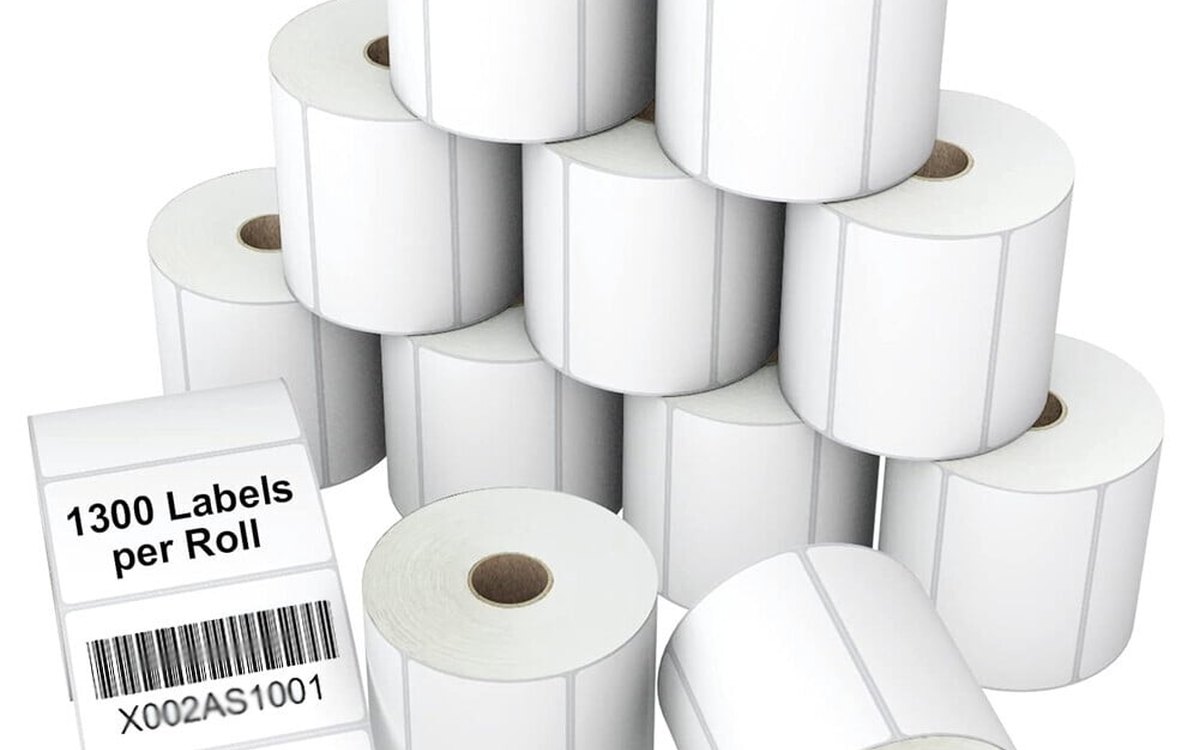
Run two or three metres empty so tension settles before the first label
Four checks before the run
- Measure the air temperature at the rack, not on the plant dashboard.
- Move the carton into 18-25 C twelve hours ahead, and leave it closed.
- Run 2-3 metres empty and listen for the peel and watch the tracking.
- Press the first label and push the corners with a finger; if they lift, stop and check temperature.
Step 4 costs two minutes and prevents most winter rework.
Common questions
Q1: Can I take a roll out of the freezer and label straight away?
A: Depends on the gap. From -18 C into a 20 C shop, it will not stick; the adhesive has not recovered. Warm 24 hours, or use a cold-application adhesive and label inside the chiller.
Q2: Can heat shorten the warm-up?
A: Not advisable. Heat softens the outside first while the core stays hard, and tension becomes unstable. If you must hurry, use a 30 C conditioning room; it is far more even than a radiator or a heat gun.
Q3: Thermal labels print lighter after warming. Why?
A: Moisture. The thermal coating is humidity sensitive; open the carton too early and condensation reaches the core, and the print goes grey. Keep the carton closed through the warm-up and reseal after use.
Q4: Is cold-application adhesive a universal winter answer?
A: No. Above 25 C its shear strength is below a standard grade, and heavy labels slide in summer. Seasonal sites do better keeping two batches and switching on shop temperature.