

New Food Label Rules Mean Bigger Type, Less Room
New food labelling rules add mandatory content: allergen declaration, a revised date format and a minimum type height. The label has not grown, so something has to give. The order matters, and shrinking type is not the answer.
The new food labelling standard adds mandatory content: allergens, a revised date format and a floor on type height for required information. The label has not grown by a millimetre.
So the first decision is not how small the type can go. It is which content gives way first. Get the order wrong and three proof rounds still will not fit.
Three changes
Allergens become mandatory. Prepackaged foods containing any of the major allergen groups must declare them clearly, near the ingredient list, instead of relying on a vague may-contain note.
Date marking is standardised. The wording and sequence for the best-before date are specified, which narrows the room for vague phrasing and means the date block needs a fixed slot in the layout.
Required information has a minimum type height. Net content, producer details and dates can no longer be squeezed in by reducing point size. Treat 1.8 mm as a working floor and confirm the exact figure in the standard text.
| Content block | Mandatory | Room to compress |
|---|---|---|
| Product name, ingredients, net content | Yes | Almost none, leading only |
| Allergen declaration | Yes, new | Small, a symbol plus short wording |
| Date and storage conditions | Yes | None, format is fixed |
| Producer or distributor details | Yes | Small, address and phone can merge |
| Selling copy and brand story | No | Large, can leave the label |
| Certification marks and decoration | No | Large, can move to the carton |
Selling copy goes first
The three lines of selling copy on the front panel are the easiest thing to lose. They do influence conversion, but they are not mandatory, and moving them to the side panel, a backing card or the product page costs the least.
That cut is the hard one.
One workable compromise: compress the copy to a single line of keywords and use a QR code for the rest. The code takes little space, but keep the quiet zone and contrast instead of shaving two millimetres off the margin.
Bilingual panels and certification marks
Products made for export and later sold domestically often carry two languages. Under the new rules the language of the sale market is enough, and dropping the other set typically releases 15 to 25 percent of the printable area.
Certification marks depend on whether the channel checks them. Organic, green and halal marks that only add appeal can move to the carton or a packing note. Where the channel inspects at receiving, they stay on the label and the space has to come out of the copy instead.
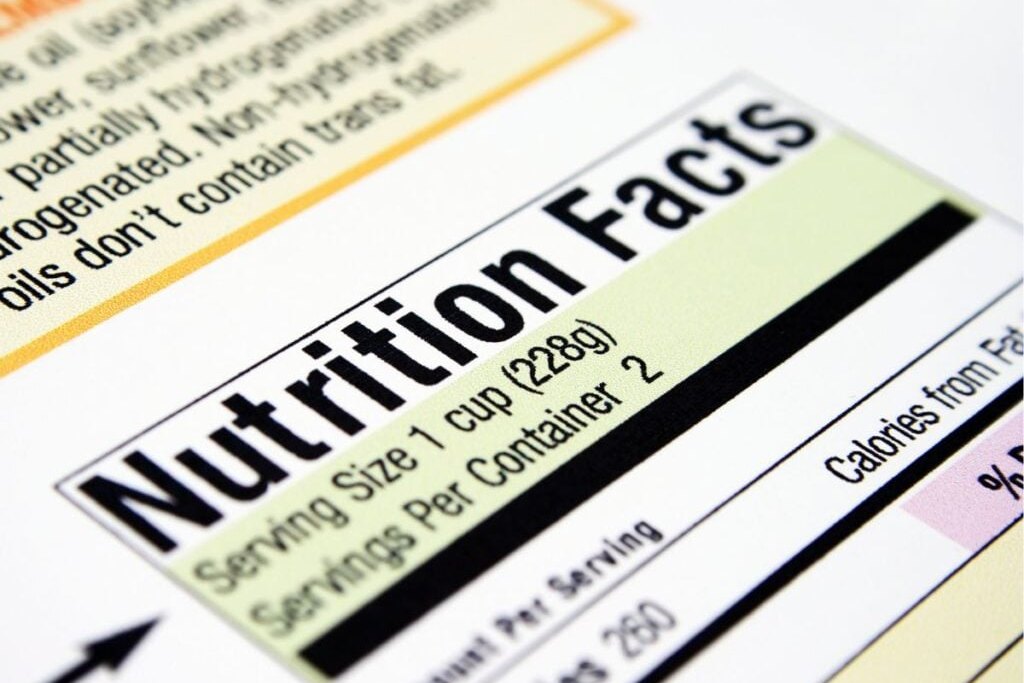
The nutrition panel is usually what squeezes the type size
When nothing fits, put it in a code
Dates, batch numbers and traceability data fall into a useful category: they must exist but nobody reads them at the shelf. A QR code can carry them while the label keeps a short prompt.
The precondition is coding capability on the line and a controlled scanning environment. A code is not a way to avoid the requirement; it is a way to store information the buyer does not need printed.
Three layouts by pack type
| Pack | Approach | Cost |
|---|---|---|
| Small bottle, label under 40 mm wide | Required content in two vertical columns, copy moved off-label | Front panel looks plain; rely on bottle shape and colour |
| Flexible pouch, 80 x 100 mm front | Name and net content on front, ingredients and allergens on back | Two-sided printing, higher cost |
| Gift carton or shipper | Label carries mandatory items, carton carries story and copy | Inner and outer must stay consistent across revisions |
Four things to settle before proofing
- List every mandatory item against the standard, with allergen and storage conditions as the usual omissions.
- Test the minimum type height at production resolution. 1.8 mm reads cleanly on coated paper and can smear on synthetic stock.
- Confirm the material suits the channel. Chilled and frozen products need a cold-resistant facestock that does not lift in the cabinet, and food-contact inks and adhesives face separate migration testing.
- Leave room for one revision. Build the layout in modules so a recipe or flavour change touches one block rather than the whole face.
Questions we get
Is the type height floor enforced? It applies to mandatory information and is checked in market surveillance. Reserving space for the upper end at layout stage costs less than a reprint.
Does the allergen statement need its own line? It needs to be conspicuous, legible and tied to the ingredient list. A short contains statement directly after the ingredients works; burying it inside the list does not.
Can the ingredient list go on the back? Yes, provided the buyer can see both faces at purchase. Front for core mandatory items and back for ingredients and allergens is common on flexible packaging, and both faces are part of the same label.
Do barcodes need revalidation after a layout change? Yes. Moving a barcode changes its position and quiet zone, so re-verify the grade on the new proof rather than assuming it still scans.