

Printed antennas on paper: would a label plant take this on?
A UK team printed RFID antennas straight onto paper with a laser, dropping both the chip and the etched aluminium. Here is what it removes, where the code lives, and what a label plant needs before quoting.
A UK company has turned the RFID label into plain paper. No chip, no etched aluminium antenna: a laser draws conductive tracks across the sheet instead. Read range reaches 4 metres, cost runs about 30 percent below a conventional inlay. When the news broke the line was still in semi-automated trial production, with no date and no capacity announced.
Start with what it takes away
Open up a standard UHF label and you find three layers: face stock, inlay, liner. The inlay carries the two expensive items, the chip and the etched aluminium antenna. Chips follow wafer lead times, antennas need etching, and the etching bath plus its waste treatment both show up on the cost sheet.
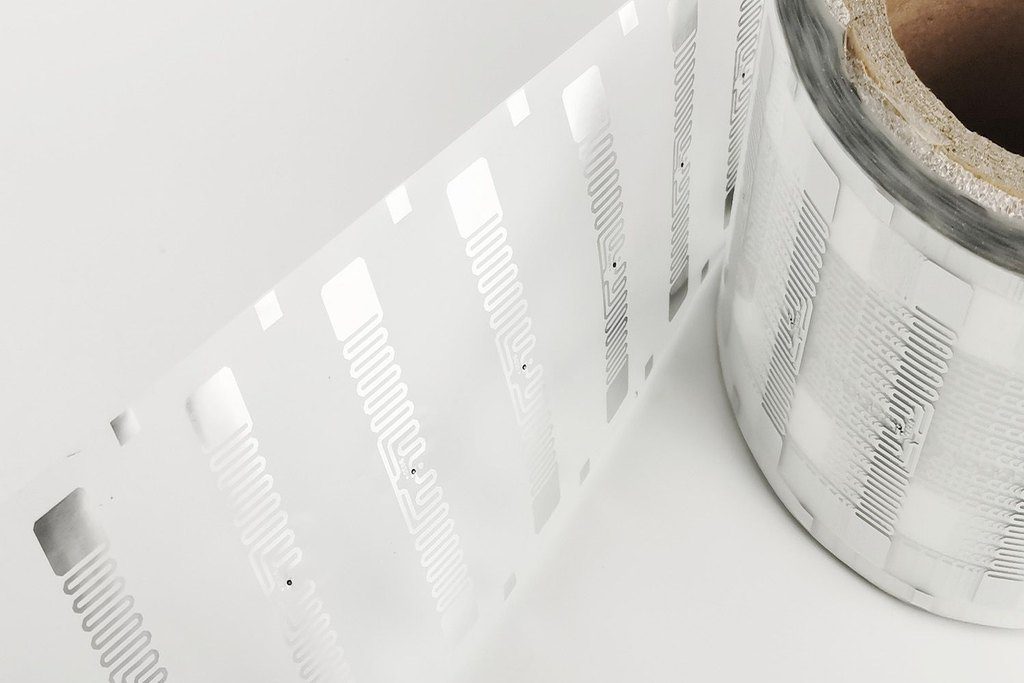
The paper route removes both at once. The laser runs over the sheet, the carbonised track becomes the antenna, the chip slot stays empty.
It runs on a different principle altogether. Making chips smaller and cheaper has nothing to do with it.
Without a chip, where does the code live
This is the question everyone asks first. A chip holds EPC and TID, a string of digits written in and read back out. A paper label has no such string.
Its identity sits in the geometry. The antenna is shaped to a specific pattern, each set of dimensions maps to a set of resonant features, and the reader sweeps the label and collects a spectrum. The pattern tells you which number you are looking at.
The trade-off is blunt. The number is fixed at plate-making, so nothing can be written on site. One antenna design, one number: print a thousand labels and you have a thousand labels carrying the same identity.
Where 4 metres sits
It depends what you are reading. For a carton, a pallet or a returnable crate, where the question is whether an item is present and which batch it belongs to, 4 metres is enough. For serialised single items, where you need to know which unit, this cannot carry it.
Conventional UHF handhelds typically manage 1 to 3 metres, fixed readers 3 to 6. Four metres lands in the middle of that band, no weakness there.
Stability is the real worry. Paper absorbs moisture, moisture shifts the dielectric constant, and the resonant point drifts with it. In a plant where humidity swings from 30 to 80 percent across the year, size the read range on the dampest week, not on the lab sheet.
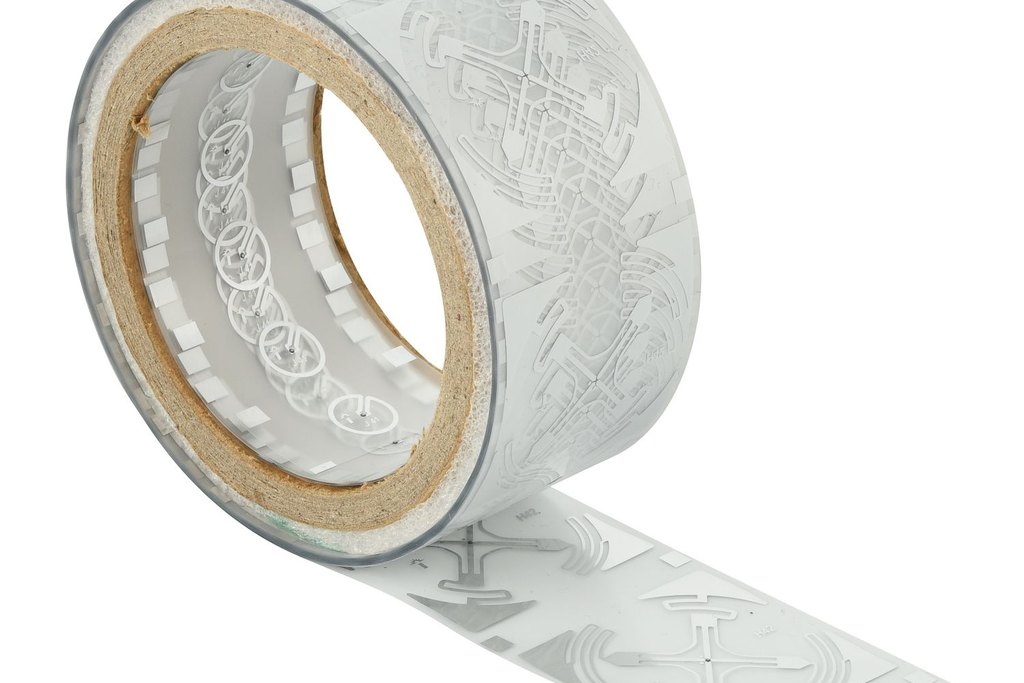
The chip takes most of the inlay material cost, and its lead time follows the wafer
Where the 30 percent comes from
| Item | Conventional UHF label | Paper-based chipless label |
|---|---|---|
| Chip | Yes, holds EPC and TID | None |
| Antenna | Aluminium or copper etched | Laser-carbonised track |
| On-site encoding | Yes, one code per label | No, fixed at plate-making |
| Read range | 1–3 m handheld, 3–6 m fixed | About 4 m, vendor figure |
| Unit cost | Baseline | About 30% lower, trial scale |
| Carbon footprint | Baseline | About 60% lower, trial scale |
| Production status | Mature | Semi-automated trial, no timeline |
The saving sits in two places. The chip comes out cleanly, since it dominates the material cost of an inlay and carries the lead-time risk as well. Etching is less visible: foil, the etch line, waste liquor, power and water all add up to a fixed overhead per square metre, and it looks worst on small runs.
The carbon figure follows the same two steps. Less aluminium, less electricity for etching, and the numbers improve on paper before anything reaches a customer.
What a pressure-sensitive plant needs first
First, the ability to form the antenna pattern. Laser-induced carbonisation needs equipment; the printed-electronics route needs conductive ink and a plate. Neither is cheap, and a line only pays for itself with steady volume behind it.
Second, batch consistency in the face stock. Two deliveries from the same supplier will differ in caliper, smoothness and absorbency. Track width shifts with them, the resonant point shifts, and read range varies run to run. This part is harder than the equipment.
Third, read-range sampling. Pull a few dozen labels per batch, run them past a fixed reader at 1 metre and at 4 metres, and log the read rate. Testing one label and calling it done is how projects fall over later.
In self-adhesive converting, a new upstream route usually moves the quotation sheet before it moves the shop floor. When a customer brings one in to compare prices, the supplier working the old process has to explain where the extra money goes.
Can you order now
No. Semi-automated trial means samples and data exist, delivery commitments do not. Projects like this still have yield ramp and customer qualification ahead of them, and a year is not slow.
What you can do today is take samples and run them under your own conditions. Which substrate, how humid the environment, how far the reader sits: measure those three and you know more than any brochure will tell you.
As for whether a label converter should build a line now, most will wait a couple of years. One more cycle in chip lead times and chip pricing will make the economics readable.
Material and process changes tend to reach pressure-sensitive stock half a step late. In-mould labels followed the same pattern: first they took a slice of the high-volume work, the rest stayed with peel-and-stick. Paper-based RFID will most likely repeat that rhythm.
Where chipped labels stand today: chips moving into labels, RFID spreading from retail into logistics. How much in-mould took: where in-mould labels stop and pressure-sensitive starts.