

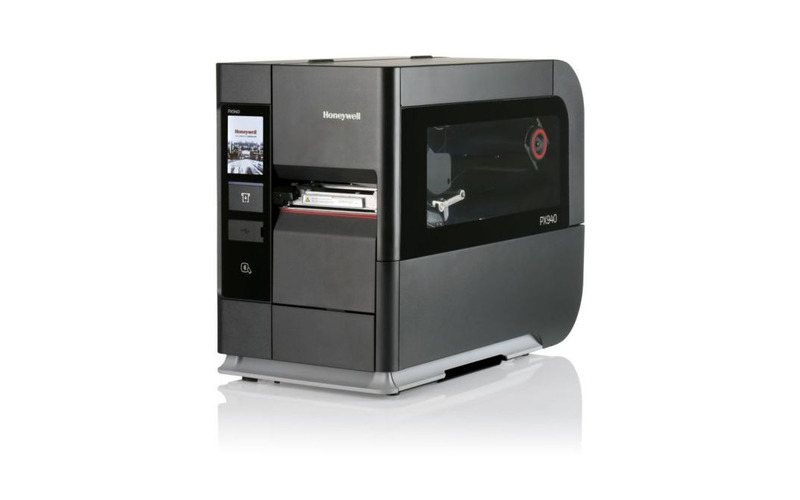
The PX940A is the flagship of Honeywell's industrial range, and the +/-0.2 mm print positioning accuracy is the headline. That number stands out among industrial printers and explains part of the price gap over comparable models.
What the accuracy solves
Small labels fail in specific ways. Shift the print slightly and the quiet zone gets clipped, and no scanner will read the code. The PX940A holds positioning within +/-0.2 mm, and dual label stop sensors keep the label stop position aligned with the print position.
The resolution options are practical: 203 dpi for routine labels, 300 dpi for small text, 600 dpi for dense 2D codes. At 203 dpi the printer runs up to 350 mm/s; at 600 dpi it drops to 150 mm/s. That is physics, not a limitation to work around.
Standalone configuration
Smart Printing lets the printer change settings and adjust formats without a host PC. When a line switches label batches, the operator handles it on the 3.5-inch colour screen instead of waiting for IT. It is a quiet feature that removes waiting time from the line.
Five command sets are on board: Fingerprint, DP, IPL, ZPL-II and DPL. Lines moving over from Zebra or Datamax hardware usually carry their templates across without rebuilding the host system.
Build and expansion
All-metal construction, quick-change printhead, tool-free platen roller removal. The media door folds down with a clear window and loads from the side. Ribbon capacity reaches 450 m in either ink-in or ink-out configuration, so roll changes come less often than on 300 m machines.
Expansion slots accept parallel, wireless and applicator interface cards, an industrial GPIO serial card, and peel-and-rewind assemblies. For automated lines, these interfaces decide whether the printer can sit inside existing equipment.
Before you order
The PX940A has no barcode verifier. If every label must be checked and faulty ones voided automatically, look at the PX940V. The chassis and print specifications are identical; the verifier is the only difference.
Buyers cluster in electronics and automotive. Electronics plants print PCB and component labels that are small and dense; automotive suppliers print one-piece-per-part codes that have to read on the first scan. During commissioning we test with the customer's actual label stock, tuning darkness and speed before handover.