

What Each Anti-Counterfeit Feature Actually Prevents
Scratch-off codes, holograms, frangible stock and tamper-evident layers all get called anti-counterfeit, but they stop different behaviour.
Ask for an anti-counterfeit label and the request often arrives as a list: hologram, scratch-off panel, QR code, frangible paper, all of them. The result costs a lot and may not address the loss the customer actually fears. Name the behaviour first. Counterfeit production, grey-market diversion, opened-and-resealed packs, and a consumer wanting to check authenticity each call for a different technique.
Letting the buyer verify
A scratch-off panel revealing a code, or a symbol that opens a verification page, gives the end user a way to check. What matters is uniqueness in the database and the query log. If one code is checked repeatedly from different places, the system should flag it. Printing the code is easy for any label converter; the strength comes from the database and the verification logic, not the silver coating. Agree who maintains that system and how long records are kept before discussing the coating.
Leave room for the symbol
Keep the quiet zone clear, do not let the scratch panel overlap the code, and make sure coating flakes do not smear across it after scratching. Printing variable codes online with thermal transfer means a new batch only changes a data file rather than a plate.
Making the whole label hard to copy
Holographic film, custom embossing, microtext and invisible fluorescent ink raise the barrier to reproducing a label on ordinary equipment. They depend on origination cost and specialist materials, so they suit high volumes with stable artwork. The weakness is at the point of use: a shopper cannot easily tell a real hologram from a good fake without training or a detection pen, which is a poorer experience than scanning a code.
Microtext and invisible inks are sensitive to print resolution and to the substrate. Film and paper behave differently, so proofs must be made on the final face stock. Fine lines that look clean on a coated paper proof can fill in on the production material.
Stopping removal and reuse
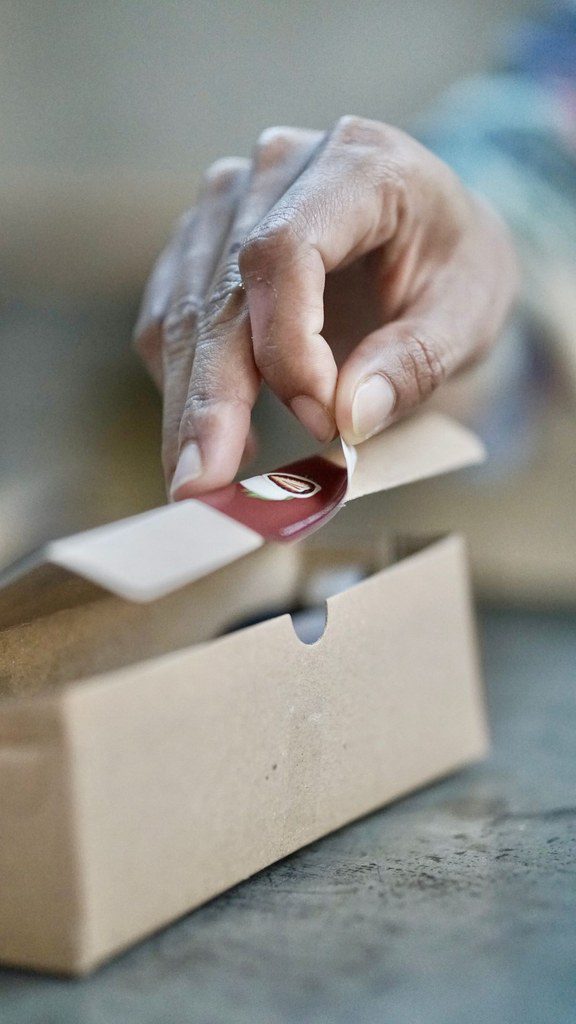
Frangible paper, void-message stock and seal labels across a closure stop someone lifting a label onto a fake pack or opening and resealing a box. The stock destroys itself or leaves a readable word on the surface, so tampering is visible. Frangible paper breaks easily on automatic applicators, so die-cut depth and waste stripping need their own settings, and very high-speed lines are a poor fit.
Test on the real surface
Void transfer depends on the pairing of adhesive and substrate. Corrugated board, laminated cartons and glass give quite different results, so one material cannot cover every pack and each surface needs a trial. If the transferred message is faint, nobody on the floor can tell tampering from a failed transfer.
Diversion is a data problem
Grey-market movement is not stopped by a material. Build parent-child links between carton, box and unit codes, bind the codes to a distributor at dispatch, and a code scanned outside its territory becomes visible. That only works if coding, inline verification, rejection and reprint, and the database write are all sound. The label is just the output. Without verification reads, duplicates and missing associations undermine the whole trace, and the data cannot be trusted when a dispute arrives.
Combine deliberately
A common package is one verification code, one physical feature, and a tamper-evident construction on the closure, scaled to budget and channel risk. At HuaiLion we start by asking which loss hurts most, then decide whether the money goes into origination, material or the data system. Filling one label with every available technique usually protects less well than doing one job thoroughly. A label also cannot replace structural features on the pack itself; closures, caps and shrink bands should be considered alongside it.